 Cart is empty


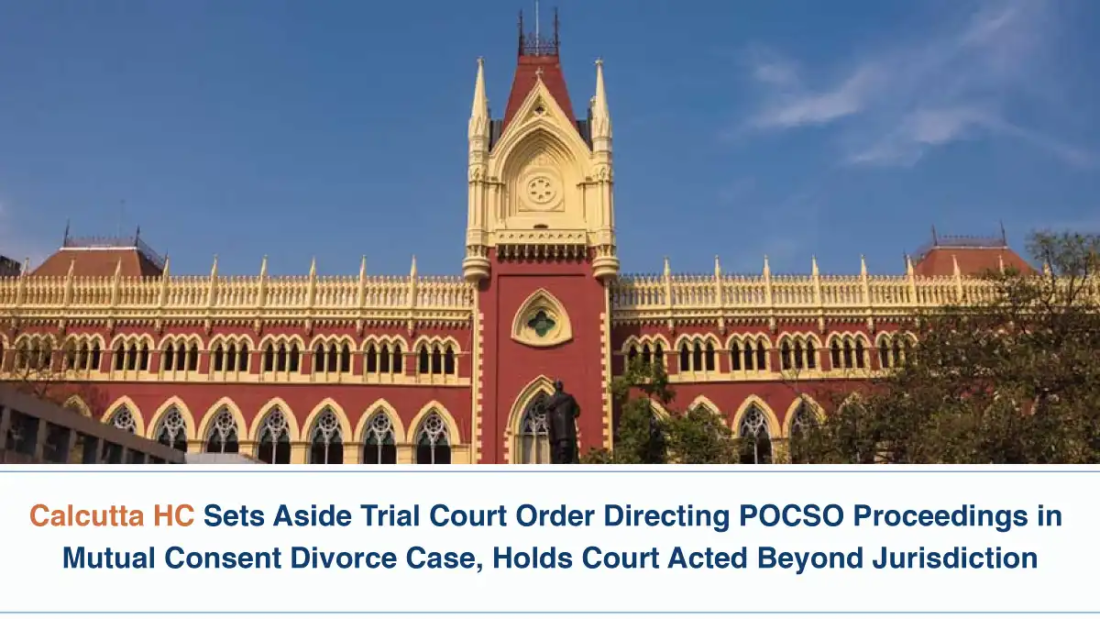
Case Name: Goyram Barman v. Madhumita Barman
Factual Background
The Calcutta High Court considered a first appeal arising from matrimonial proceedings between Goyram Barman and Madhumita Barman. The parties had filed an application under Section 13B of the Hindu Marriage Act, 1955 seeking divorce by mutual consent. The Trial Judge dismissed the application on the grounds that the marriage had been solemnised in violation of the Prohibition of Child Marriage Act, 2006. The Trial Judge also directed a copy of the order to the Officer-in-Charge of Bhagwanpur Police Station to treat it as information under Section 19 of the Protection of Children from Sexual Offences Act, 2012 and register a case. The appellant challenged this course, arguing that the Trial Court, while dealing with a mutual-consent divorce petition, had exceeded its jurisdiction by directing registration of a POCSO case. It was also argued that no POCSO offence had been alleged and that a child marriage under Section 3 of the Prohibition of Child Marriage Act is voidable at the option of the contracting party who was a child.
Court’s Analysis
The Division Bench held that the impugned judgment was palpably contrary to law. First, a Court dealing with Section 13B of the Hindu Marriage Act is governed by the parameters of that provision and, at most, the Hindu Marriage Act as a whole. Its task was to ascertain whether the statutory requirements for mutual-consent divorce were satisfied. The Trial Judge therefore acted de hors jurisdiction by directing registration of a criminal case under the POCSO Act. Second, the Hindu Marriage Act contains no provision, within its statutory framework, for declaring an under-age marriage void or voidable. Third, under Section 3 of the Prohibition of Child Marriage Act, 2006, a child marriage is merely voidable at the option of the contracting party who was a child. Since neither party sought a declaration that the marriage was void or voidable and both parties approached the Court seeking divorce, the marriage could not be treated as voidable in those proceedings. The Bench further found that the Section 13B petition contained no allegation amounting to an offence under the POCSO Act. Consequently, the Trial Judge could not assume the role of “any person” under Section 19(1) of the POCSO Act and report a non-existent offence. The Bench also noted that the Trial Judge was functioning as the POCSO Court in the district concerned. Directing registration of a complaint which could ultimately come before the same judge created a serious natural-justice problem, since a person cannot be the judge of his or her own cause.
Order of the Court
The High Court allowed the appeal on consent and set aside Order No. 03 dated 23 December 2025 and the judgment of the Additional District Judge, First Court at Contai, District Purba Medinipur, in Matrimonial Suit No. 117 of 2025. The Section 13B application was remanded for fresh adjudication on its own merits in accordance with law, with the Trial Judge directed to adhere to the timelines stipulated under Section 13B. Any action already taken pursuant to the impugned judgment, including registration of a case or complaint, stood revoked and cancelled and was to be reversed by the concerned authorities. The connected application was disposed of and there was no order as to costs.
Key Takeaway
A matrimonial Court exercising jurisdiction under Section 13B cannot travel beyond the statutory framework of the proceedings and assume criminal jurisdiction merely because facts may raise concerns regarding child marriage or an alleged POCSO offence. A child marriage is not automatically void under Section 3 of the Prohibition of Child Marriage Act; it is generally voidable at the option of the contracting party who was a child. Further, Section 19 of the POCSO Act cannot be invoked to create a criminal complaint where the matrimonial pleadings disclose no offence. The judgment also reinforces the natural-justice principle that a judge should not direct a complaint which may ultimately place that same judge in the position of adjudicating the resulting criminal case.
Written by Adv. K. Sri Hamsa