OUR STORY

Child Safety
is always
at work

We have always been committed to the work of keeping children safe. This vertical grew at the intersection of that commitment and the realities of professional spaces. It has taken shape through ongoing engagement with stakeholders, including employers, principals, and educators, room by room, disclosure by disclosure, question by question.
Perpetrators Known to Child
0 %

1 in 5

Girls Face Abuse Before 18

POCSO Cases still Pending
0 L
HOW IT BEGAN

The work found us
room by room

The work took shape through the conversations we were already part of. It became clearer with each space we stepped into.

Through our work on building safe workspaces through end-to-end implementation of the Prevention of Sexual Harassment of Women at Workplace (Prevention, Prohibition and Redressal) Act, 2013 (POSH Act), we were already engaging with organisations that had direct and indirect touchpoints with children.

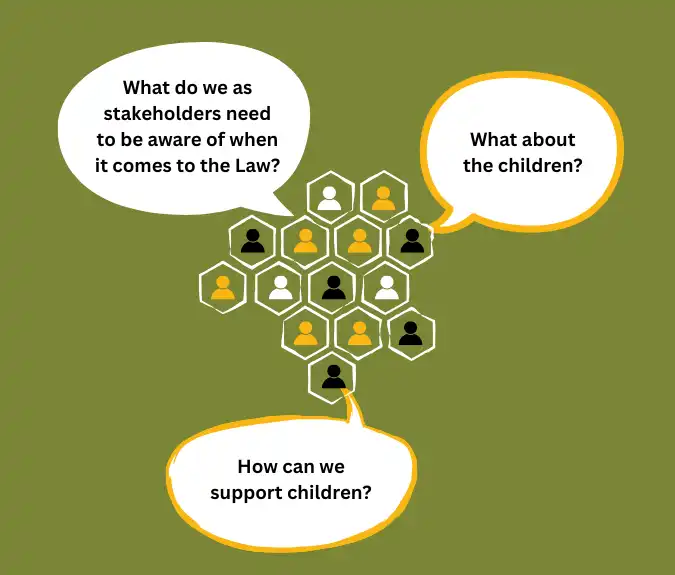
In these spaces, we began to encounter the overlap between workplace safety and child protection. What started as conversations within professional spaces like academic institutions, crèches, media and production houses, and other such environments, quickly brought up some recurring questions:

What about the children?

What do we as stakeholders need to be aware of when it comes to the Law?

How can we support children?

As organisations sought guidance, the need went beyond sessions or policies.

Real situations emerged, disclosures surfaced, and it became clear that many professionals were being asked to respond without the training or frameworks to do so.

Child Safety at Work grew from this intersection of POSH and POCSO, shaped by on ground realities and the need for responses that are legally informed, psychologically sound, and practically applicable.

WHAT WE PRIORITISE IN OUR WORK

We’re dismantling the myths that maintain the status quo

1) Silence is not a sign that things are okay

There are many myths about child Sexual Abuse (CSA) that make it harder to identify, and this is one of them. When children don’t complain or suddenly go quiet, it does not mean everything is fine. In fact, when a child becomes withdrawn, less expressive, or unusually silent, it can be a sign that something is not okay. These are moments to gently check in and let them know they are safe to talk.

2) Vulnerability is not about only gender, and yes boys can experience sexual assault too

We often focus on protecting girls, but boys can experience harm too.

Qualitative work consistently shows boys are as vulnerable as girls, sometimes more so. But psychosocial narratives prevent disclosure. The gap in the numbers is not a research problem. It is a cultural one

Furthermore, data that covers gender as a binary of only boy and girl, often misses the mark when it comes to the diversity of the gender spectrum.

It is important to note that children who do not identify strictly as boys or girls are often even more at risk.

Every child, across the gender spectrum, deserves to feel safe, to be taken seriously, and to be supported when they speak up.

3) The Stranger is not the only danger

Almost every conversation about child safety is built around one idea: the stranger. Lock the gates. Don’t talk to people you don’t know. Stranger danger.

The harder question -the one most conversations avoid, is what we do when harm comes from the within spaces and relationships that are supposed to be safe.

What happens when the danger is the relative at the dinner table? Or the teacher who stays back after class, the older cousin everyone loves, the community member everyone trusts?

Most adults have no answer. Not because they don’t love the child, but because social norms and pressures may not provide the space to reflect on that.

Qualitative work consistently shows boys are as vulnerable as girls — sometimes more. But psychosocial narratives prevent disclosure. The gap in the numbers is not a research problem. It is a cultural one

Child safety conversations have been built around comfort. Real child safety requires us to move beyond it.

96.8%

of perpetrators in POCSO cases are known to the child a family member, teacher, coach, neighbour, or peer. Not a stranger at the gate.

NCRB – CRIME IN INDIA, 2023

1 in 5

girls and women globally experienced sexual violence before 18. India's prevalence is among the highest in the world — nearly 31%.

UNICEF 2024 – LANCET / IHME 2025

2.43L

POCSO cases pending in Special Courts as of 2023. The law mandated trials within one year. The reality is a wait that stretches across childhoods.

LOK SABHA
WHAT WE BELIEVE

Child safety begins
with the child

Most child safety frameworks are built for adults. The child appears in them as the object of protection – a passive, voiceless, waiting to be kept safe by the system around them.

We believe the current framing overlooks what really matters.

Safety begins with giving a child vocabulary for their own body. With teaching them that no adult, no matter how loved or trusted, has the right to override their boundaries.
This goes further to building in the child the knowledge that if something happens, it is never their fault. And that there is someone they can tell.

But before we can empower a child, we almost always need to work with the parent. Because most parents did not grow up with this. They were not taught that their body was their own. They cannot give their child something they themselves never received.

Empowering children requires empowering the adults who love them which means helping those adults reckon with what was never given to them.

WHAT CHILD SAFETY AT WORK MEANS

Two truths, held together.

We work with organisations where children are present, helping them meet their responsibility. Wherever a child enters a space, that organisation carries a duty of care.

And deeper: child safety is always at work. In every interaction, every space a child moves through. In the word chosen and the one that wasn’t. In the disclosure heard — and the one met with silence.

We named ourselves Child Safety at Work because this work is never finished. It is continuous, collective, and it belongs to every adult who has a child in their world.

Truth One - Literal

Schools. Crèches. Retail floors. Hotels. Aviation. Manufacturing communities. Wherever children and organisations intersect, responsibility exists. We help organisations meet it with policy, training, and living practice.

Truth Two - Always

Safety is working all the time, in every direction in every classroom, every home, every group chat, every moment of trust between an adult and a child. The question is only whether it is working for the child.

WHAT OUR LOGO STANDS FOR

Every element carries what we hope for.

Our logo is not decoration. It is a declaration of what we believe child safety must look and feel like. The three stars indicate:

Awareness

Alertness. The willingness to understand what child safety truly demands, even when what we see is uncomfortable. Safety begins with seeing clearly.

Protection

The deliberate, continuous work of building environments where children are safer: in their bodies, relationships, and institutions. Practised every day. Where children are active participants, not passive.

Accountability

The obligation to speak when something is wrong; to stand with the child, and ensure the response carries both legal rigour and human care.

The meaning behind the image of the child and the curve that holds without restricting

At the centre is a child, seated and still. Not cowering. Simply present and trusting. The sweeping curve surrounding them is not a wall. It moves. It embraces without enclosing. Because protection, as we understand it, is not control. It is care that is continuous, surrounding, always in motion. Safety is never finished. It is always being built.

The child and the curve that holds without restricting

At the centre is a child, seated and still. Not cowering. Simply present and trusting. The sweeping curve surrounding them is not a wall. It moves. It embraces without enclosing. Because protection, as we understand it, is not control. It is care continuous, surrounding, always in motion. Safety is never finished. It is always being built.

AND SO
When a teacher notices a change in a child and stays with it.

When an organisation decides safety is not someone else’s portfolio.

When a parent finds the words that they weren’t sure they had.

When a child is believed.

We move from awareness to action ensuring every child is safe.
Child Safety at Work - A Vertical of Equilibrio Advisory LLP
Shopping Basket