 Cart is empty


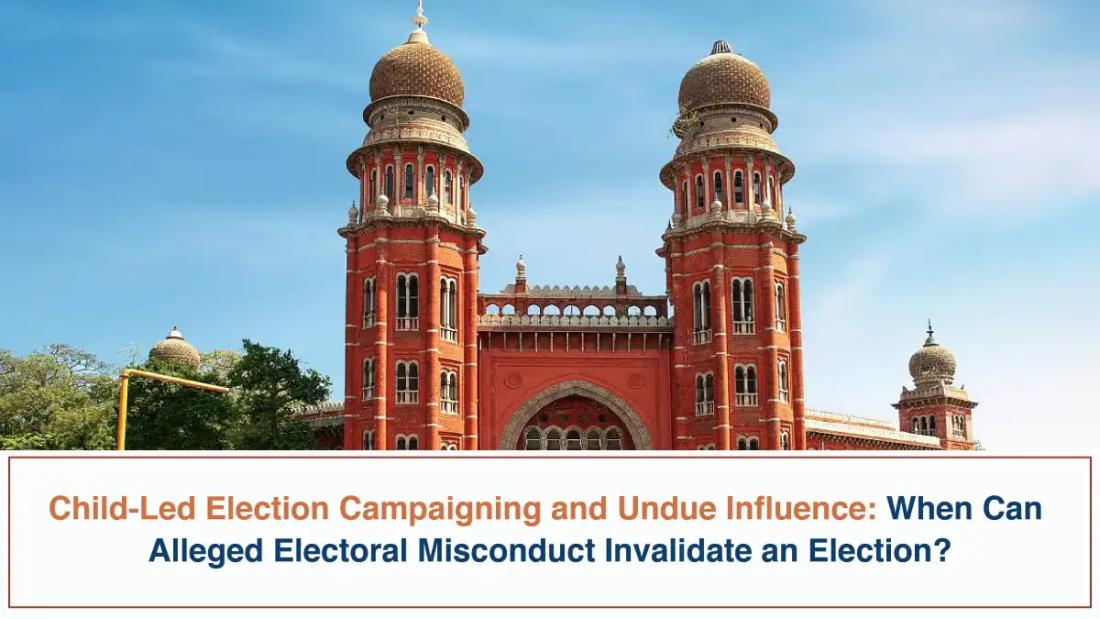
Case Name: K. Sivakumar v. Rajendran R.
Factual Background
The case arose from the 2026 Tamil Nadu Legislative Assembly elections, in which Rajendran R., the returned candidate from the Salem North Assembly Constituency, secured 85,710 votes, defeating K. Sivakumar, the DMK candidate, who secured 71,676 votes. Sivakumar filed an election petition seeking to declare Rajendran’s election null and void under Sections 100(1)(b), 100(1)(d)(ii) and 100(1)(d)(iv) of the Representation of the People Act, 1951.
The election petition alleged, first, that children had been involved in election campaigning for the returned candidate, contrary to the Election Commission of India’s circular dated 5 February 2024 prohibiting the use of children in election-related activities. Complaints had been submitted to the election authorities, accompanied by video recordings of children participating in campaign rallies.
Secondly, the petitioner alleged that Joseph Vijay, president of the returned candidate’s political party, had delivered a speech on 21 April 2026 encouraging children to persuade their parents and other family members to vote for the party. Social media videos allegedly depicted children pressuring, threatening and emotionally manipulating family members into supporting the party’s candidate. The petitioner contended that this conduct constituted undue influence and a corrupt practice under Section 123(2) of the Act.
The returned candidate subsequently filed an application seeking rejection of the election petition under Order VII Rule 11 of the Code of Civil Procedure, 1908, contending that the pleaded facts did not disclose a legally sustainable ground for invalidating the election.
Court’s Analysis
The Madras High Court examined whether the alleged violations constituted legally recognised grounds for declaring an election void. It held that an election petition is a statutory remedy that must satisfy the specific requirements prescribed under the Representation of the People Act, 1951.
Regarding the Election Commission’s circular, the Court observed that although it had been issued under the Commission’s constitutional powers under Article 324, its violation did not, by itself, constitute non-compliance with the Constitution, the Act, or Rules or Orders made under the Act within the meaning of Section 100(1)(d)(iv). Consequently, the alleged violation could not independently justify setting aside the election under that provision.
On undue influence, the Court interpreted Section 123(2) alongside Section 100 of the Act. It observed that the alleged interference had to satisfy the statutory requirements concerning the candidate, their agent or another person acting with the candidate’s or election agent’s consent. The speech attributed to the political party’s president did not, on the pleaded facts, satisfy these requirements.
The Court further distinguished persuasion from undue influence. Referring to the principle that interference must overpower an elector’s free will, it held that children’s attempts to persuade their parents, even through emotionally charged conduct, did not establish that the adults’ electoral freedom had been overpowered. It also observed that adults had facilitated the creation and circulation of the videos.
Order of the Court
The High Court allowed the application and rejected the election petition, finding that the pleaded allegations did not disclose a cause of action for the relief sought. No order as to costs was made, and the petitioner’s security deposit was directed to be refunded.
Key Takeaway
A violation of Election Commission guidelines does not automatically invalidate an election unless it satisfies a statutory ground under the Representation of the People Act, 1951. Similarly, undue influence under Section 123(2) requires legally sufficient interference with the free exercise of electoral rights and compliance with the statutory requirements concerning attribution to the candidate or their authorised agents.
Written by Adv. K. Sri Hamsa