 Cart is empty


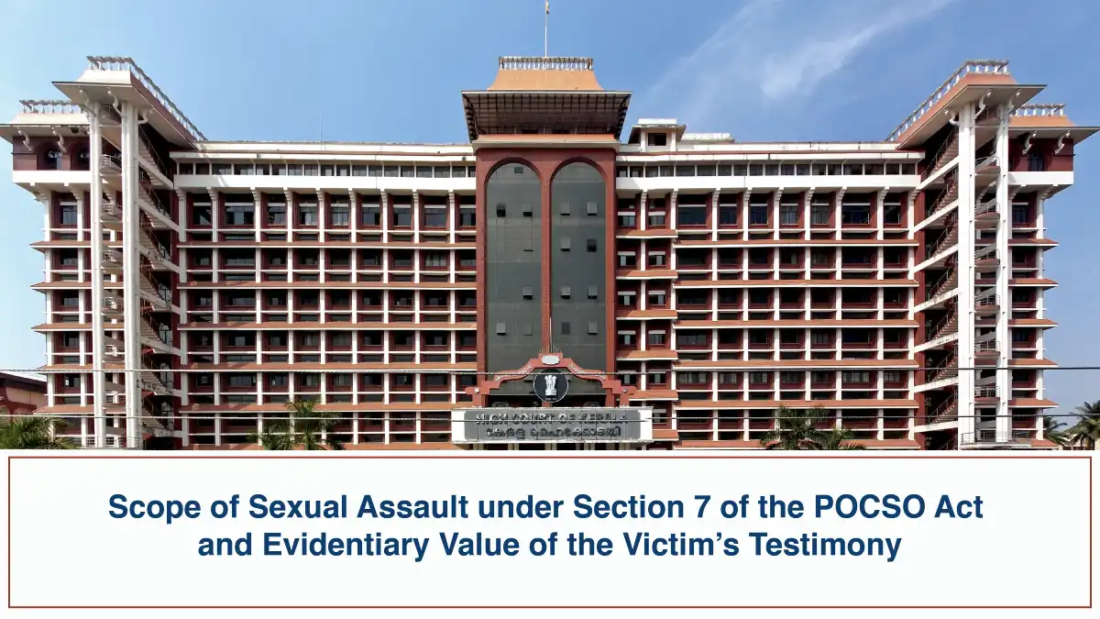
Case: Ebin A.V. v. State of Kerala
Factual Background
The appellant was prosecuted for offences under Section 376(2)(n) of the Indian Penal Code and Sections 3(a), 5(l), 6, 7 and 8 of the Protection of Children from Sexual Offences Act, 2012 (POCSO Act). The prosecution alleged that during April and May 2016, the accused committed repeated acts of sexual assault against a 17-year-old girl. Following investigation, the matter was tried before the Special Court for cases relating to atrocities and sexual violence against women and children, Ernakulam. During trial, the prosecution examined fifteen witnesses and produced documentary evidence, while the accused did not adduce any defence evidence.
During her testimony, the victim stated that the accused, whom she had come to know through a friend, visited her residence on three occasions during her school vacation. She deposed that he entered the house at night, came to her room, kissed and hugged her, and touched her private parts with her consent. However, she expressly denied that sexual intercourse had taken place and was consequently declared hostile by the prosecution on that aspect. Despite this, her testimony regarding the acts of physical intimacy and sexual touching remained consistent and was not challenged during cross-examination. Her account was supported by the evidence of her father, sister, the Child Welfare Committee proceedings, and other documentary evidence establishing the place of occurrence and the victim’s age.
The Special Court acquitted the accused of the charges relating to rape and aggravated penetrative sexual assault but convicted him under Sections 7 and 8 of the POCSO Act for sexual assault, sentencing him to three years’ rigorous imprisonment and a fine of ₹10,000. The accused challenged the conviction before the Kerala High Court on several grounds, including contradictions in the victim’s testimony, failure to prove minority, constitutional validity of the age threshold under the POCSO Act, admissibility of medical evidence, lack of corroboration, and ineffective legal representation.
Court’s Analysis
The High Court held that the conviction under Sections 7 and 8 of the POCSO Act was legally sustainable despite the victim turning hostile regarding the allegation of sexual intercourse. The Court observed that the prosecution had not secured a conviction for rape but only for sexual assault under Section 7, which criminalises physical contact with sexual intent without penetration. The victim’s testimony clearly established that the accused kissed her, hugged her, and touched her private parts on multiple occasions. These allegations directly satisfied the statutory ingredients of Section 7. Importantly, the defence failed to cross-examine the victim on these allegations or suggest that they were false. Consequently, this portion of her testimony remained unshaken and could safely be relied upon by the Court.
Rejecting the appellant’s contention that the prosecution case had collapsed because the victim denied sexual intercourse, the Court reiterated that the testimony of a hostile witness is not to be discarded in its entirety. Courts are entitled to rely upon those portions of a witness’s evidence that are found to be credible and consistent with the surrounding circumstances. Since the victim’s evidence regarding sexual touching remained reliable and unchallenged, her partial hostility did not undermine the prosecution’s case under Section 7 of the POCSO Act.
Addressing the submission that conviction could not rest upon the sole testimony of the victim, the High Court reaffirmed the settled principle that the testimony of a prosecutrix, if trustworthy and reliable, requires no independent corroboration. In the present case, the victim’s account was not only intrinsically reliable but was also supported by the testimony of her family members, the Child Welfare Committee proceedings, and documentary evidence regarding the scene of occurrence and the victim’s age. The Court therefore concluded that the prosecution had successfully proved the offence beyond reasonable doubt and that the statutory minimum sentence prescribed under Sections 7 and 8 of the POCSO Act could not be reduced.
Order of the Court
The Kerala High Court dismissed the criminal appeal and affirmed the conviction and sentence imposed by the Special Court under Sections 7 and 8 of the POCSO Act. The sentence of three years’ rigorous imprisonment and fine of ₹10,000 was upheld, the Court observing that it represented the statutory minimum punishment and therefore admitted no reduction.
Written by Adv. K. Sri Hamsa