 Cart is empty


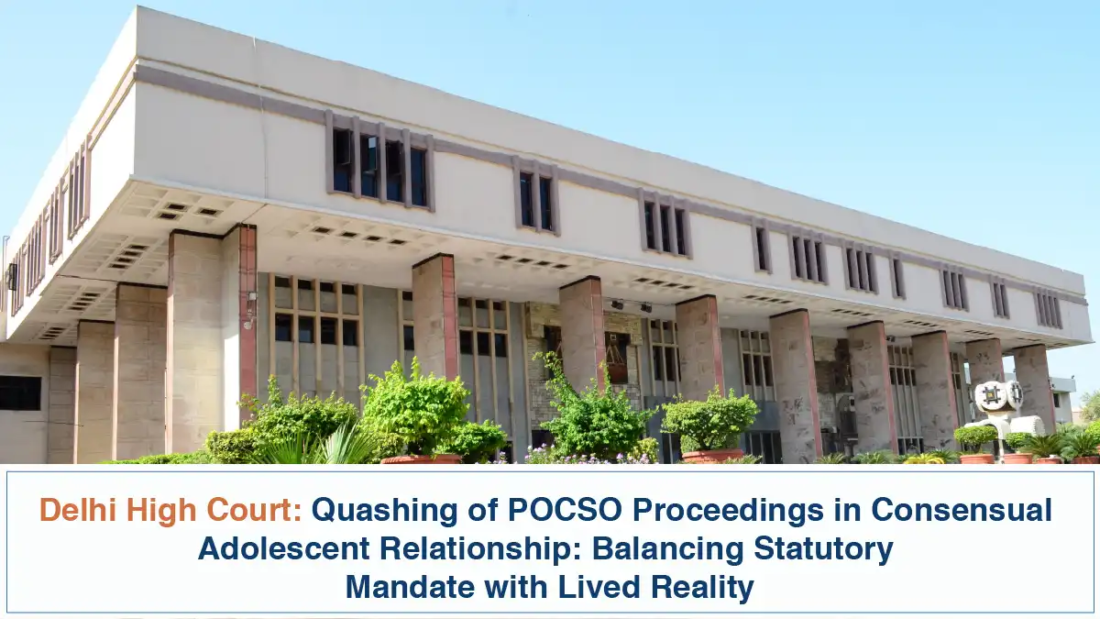
Case: Harmeet Singh v. State of GNCT Delhi & Anr.
Factual Background
The present petition was filed seeking quashing of an FIR registered under Section 64(1) of the Bharatiya Nyaya Sanhita, 2023 and Section 6 of the Protection of Children from Sexual Offences Act, 2012. At the time of the alleged offence, the petitioner was approximately 22 years old, while the prosecutrix was about 17 years old, thereby attracting the provisions of the POCSO Act.
The FIR was not lodged at the instance of the prosecutrix. Instead, it was registered upon information provided by doctors at Safdarjung Hospital when the prosecutrix presented for delivery of her child, in compliance with statutory reporting obligations.
Subsequently, the petitioner and the prosecutrix solemnised their marriage and were residing together as husband and wife along with their child. During the proceedings, the prosecutrix submitted an affidavit stating that she had entered the relationship and marriage voluntarily, had no grievance against the petitioner, and did not wish to pursue the criminal proceedings. She further stated that continuation of the case would adversely affect her family life and the upbringing of her child.
Court’s Analysis
The Court was confronted with the question of whether criminal proceedings under the POCSO Act should continue where the prosecutrix, though a minor at the time of the alleged offence, denied having suffered any harm or injury.
The Court noted that under the POCSO Act, the consent of a minor is legally irrelevant, and any sexual activity involving a minor is deemed an offence. However, it examined the definition of a “victim” under criminal law, which requires that a person must have suffered some loss or injury because of the alleged act. In the present case, the prosecutrix categorically denied any such harm and asserted that she had voluntarily entered the relationship.
The Court highlighted the distinction between a de jure victim, created by operation of law due to minority, and a de facto victim, who has suffered harm. It observed that in certain cases, the statutory framework may result in recognition of victimhood even in the absence of real injury.
Further, the Court considered the consequences of continuing prosecution in such circumstances. It noted that the prosecutrix was now married to the petitioner, living with him, and had a child from the relationship. Insistence on strict application of the law, without regard to these realities, would lead to serious prejudice to the prosecutrix herself, including disruption of her family life and deprivation of support.
The Court also observed that in similar factual scenarios, courts have exercised their powers to quash proceedings where continuation would serve no useful purpose and would instead result in injustice. It emphasised that the judicial process must not be used in a manner that causes greater harm to the very person whom the law seeks to protect.
Accordingly, the Court adopted a purposive approach, holding that rigid enforcement of the statute in the present case would defeat the ends of justice.
Order of the Court
The Court allowed the petition and quashed the FIR along with all consequential proceedings arising therefrom.
Key Takeaway
The judgment reflects a pragmatic approach in cases under the POCSO Act involving consensual relationships, recognising that strict statutory application may, in certain circumstances, result in injustice. Where the prosecutrix denies harm and continuation of proceedings would adversely affect her welfare and that of her family, courts may exercise their powers to quash such proceedings to secure the ends of justice.
Written by Adv. K. Sri Hamsa