 Cart is empty

Factual Background
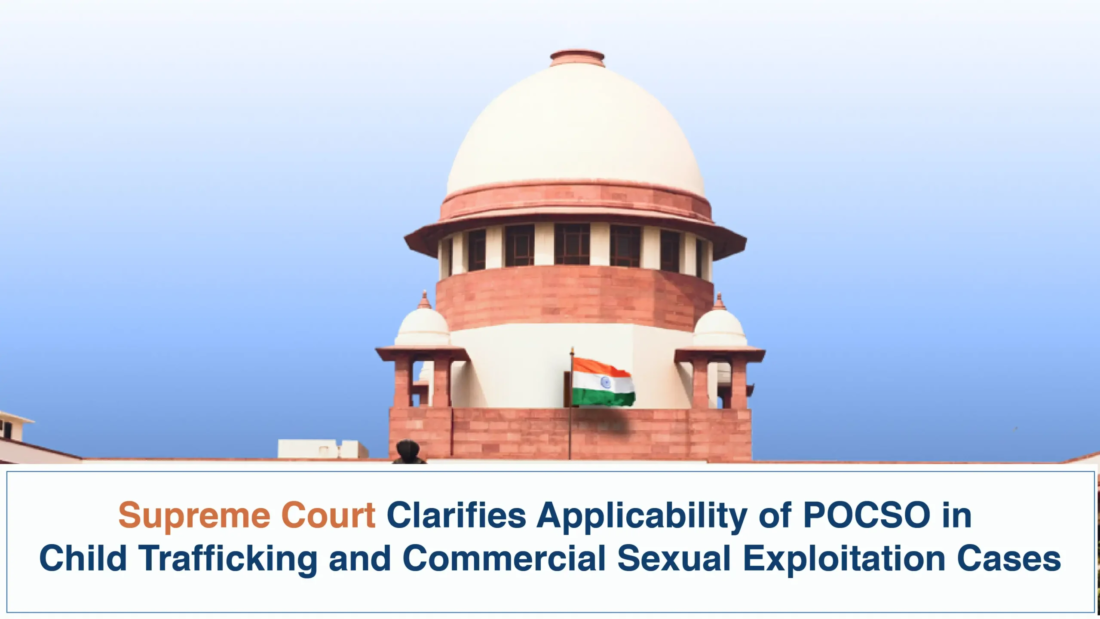
The matter arose from a long-pending public interest litigation filed by Prajwala, an anti-trafficking organisation, concerning trafficking of women and children for commercial sexual exploitation (CSE). The petition sought stronger institutional mechanisms for rescue, protection, rehabilitation, and reintegration of trafficking survivors. While the primary focus of the litigation was trafficking, the Supreme Court also examined the legal protections available to child victims who are trafficked and subjected to sexual exploitation.
Court’s Analysis
While analysing the legal framework governing trafficking for commercial sexual exploitation, the Supreme Court considered the interplay between the Bharatiya Nyaya Sanhita, 2023 (BNS), the Immoral Traffic (Prevention) Act, 1956 (ITPA), the Juvenile Justice Act, and the Protection of Children from Sexual Offences Act, 2012 (POCSO). The Court observed that where the victim of trafficking for commercial sexual exploitation is a child, the protections available under POCSO assume special significance.
The Court noted that Indian law treats all forms of sexual exploitation involving children as inherently non-consensual. Consequently, where a trafficked child is subjected to acts constituting penetrative sexual assault, aggravated penetrative sexual assault, sexual assault, sexual harassment, or offences relating to child sexual abuse material, the provisions of the POCSO Act may be invoked in addition to offences under trafficking laws. The Court clarified that the applicability of POCSO does not stand excluded merely because the offence also constitutes trafficking or commercial sexual exploitation. Rather, the statutes operate in a complementary manner to ensure comprehensive protection of child victims.
The Court further highlighted that once POCSO is attracted, the statutory safeguards available under the Act become applicable, including child-friendly procedures for reporting offences, recording statements, medical examination, investigation, and trial. The judgment therefore recognises that trafficked children are entitled not only to anti-trafficking protections but also to the enhanced procedural and substantive safeguards specifically designed for child victims under POCSO.
Order of the Court
The Supreme Court held that where a victim of commercial sexual exploitation is a minor, perpetrators may be prosecuted under the POCSO Act in addition to applicable trafficking-related offences under the BNS and the ITPA. The Court also issued a comprehensive Victim Protection Plan containing directions on rescue, rehabilitation, reintegration, prosecution, and institutional coordination for trafficking survivors.
Key Takeaway
The judgment strengthens the intersection between India’s anti-trafficking and child-protection frameworks. The Supreme Court clarified that child trafficking cases involving sexual exploitation should not be viewed solely through the lens of trafficking laws. Where the victim is a child, investigating agencies and prosecutors must also examine the applicability of POCSO offences and extend the child-sensitive protections mandated under the Act. The decision reinforces the principle that trafficked children are entitled to the full benefit of POCSO’s substantive offences and procedural safeguards, thereby ensuring a more victim-centric approach to prosecution and rehabilitation.
Written by Adv. K. Sri Hamsa