 Cart is empty


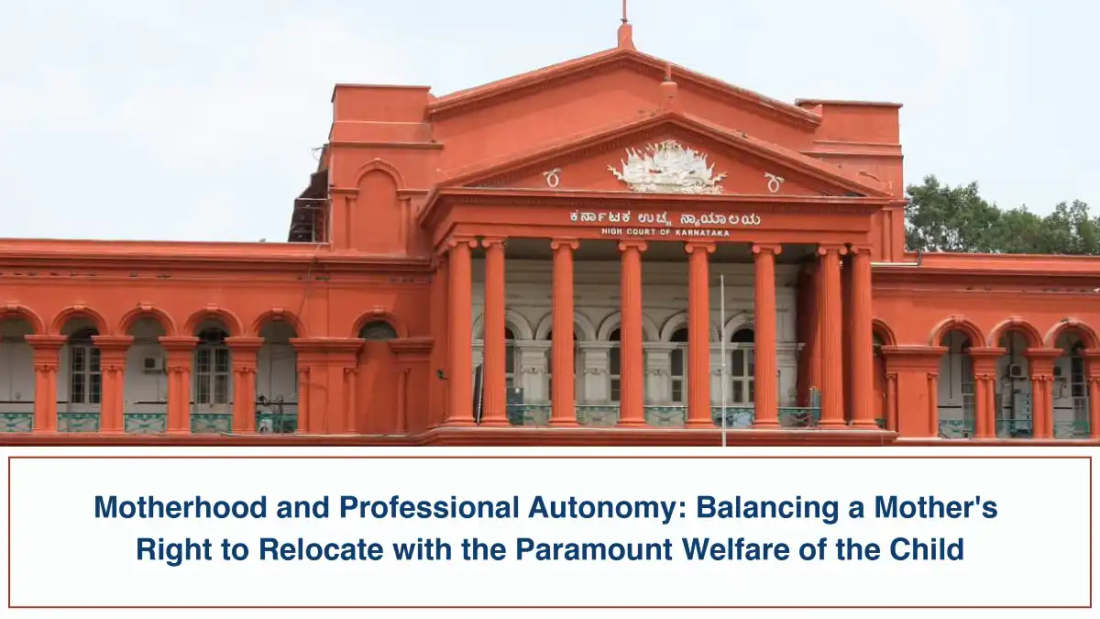
Case Name: R v. S
Factual Background
The petitioner (R), the father, and the respondent (S), the mother, were married in January 2013 and have a minor son born in December 2014. Following their separation, the child remained in the mother’s care. The mother, an ophthalmologist, secured a professional opportunity in the United Kingdom and approached the Family Court seeking directions concerning the child’s passport, visa formalities and permission to take the child along with her.
On 16 April 2025, the Family Court directed the father to hand over the child’s original passport and provide the necessary consent for passport renewal and obtaining a United Kingdom visa. The order also permitted the mother to take the child to the UK, while providing for communication and visitation arrangements between the father and child. A subsequent order dated 13 October 2025 directed the father to cooperate with the visa formalities.
The father challenged these orders before the High Court. Subsequently, because the child’s travel formalities were delayed, the mother travelled to the UK for her professional commitments, while the child temporarily remained in India under the care of maternal relatives. The father then sought a change in interim custody, which was rejected by the Family Court on 15 April 2026. Aggrieved by these orders, the father approached the High Court through connected writ petitions.
Court’s Analysis
The High Court reiterated that the welfare of the child is the paramount consideration in determining custody and relocation disputes. It examined whether the Family Court had exceeded its jurisdiction by permitting the child’s relocation without a separate prayer specifically seeking relocation. The Court held that the mother’s application, read as a whole, disclosed her intention to take the child to the United Kingdom, and the father had an opportunity to oppose that proposal. Accordingly, the Family Court had not introduced an entirely new controversy or granted relief without notice.
The Court observed that the mother’s temporary departure to the UK, leaving the child with maternal relatives because of delays in completing travel formalities, did not amount to abandonment of parental responsibility. Assistance provided by grandparents or relatives does not, by itself, constitute a transfer of custody. The Court further held that a mother’s professional ambitions and motherhood are not mutually exclusive. Marriage and motherhood cannot deprive a woman of her freedom to pursue legitimate professional opportunities.
The Court also considered the father’s apprehension of parental alienation. It observed that geographical separation does not automatically amount to parental alienation and that such allegations must be supported by identifiable conduct. The child’s preference to accompany the mother while maintaining a relationship with the father was also considered relevant, though not conclusive.
Ultimately, the Court found no sufficient material to establish that relocation to the UK would be detrimental to the child’s welfare or that the mother was incapable of providing a suitable environment.
Order of the Court
The Court dismissed W.P. No. 38415 of 2025 as infructuous and W.P. No. 14682 of 2026. W.P. No. 37759 of 2025 was disposed of, permitting the mother to take the child to the UK. She must facilitate telephone/video communication between father and child for 20 minutes daily. The child shall visit India twice yearly during holidays and spend 75% of vacation with the father. If the father visits the UK, the mother must facilitate parenting time. Both parents must preserve the child’s relationship with the other. These arrangements remain modifiable by the competent court, having regard to the child’s welfare.
Written by Adv. K. Sri Hamsa