 Cart is empty

Case Name: Dr. Jaya Thakur v. Government of India & Others
Factual Background
The proceedings concerned the implementation of the Supreme Court’s earlier judgment recognising menstrual hygiene and menstrual health as components of the fundamental right to life under Article 21 of the Constitution. The Court had directed States and Union Territories to consider deficiencies identified in its order dated 1 September 2026 and report on the measures being taken to address them.
During the subsequent hearing on 13 October 2026, the Union Government informed the Court that it had taken up the matter with the States and Union Territories and sought information about the implementation of the judgment. However, the States and Union Territories had not responded to the Union’s requests.
The proceedings highlighted concerns regarding the practical implementation of menstrual-health-related constitutional protections, particularly for young girls in remote areas who may discontinue their education because of inadequate menstrual hygiene facilities and related difficulties.
Court’s Analysis
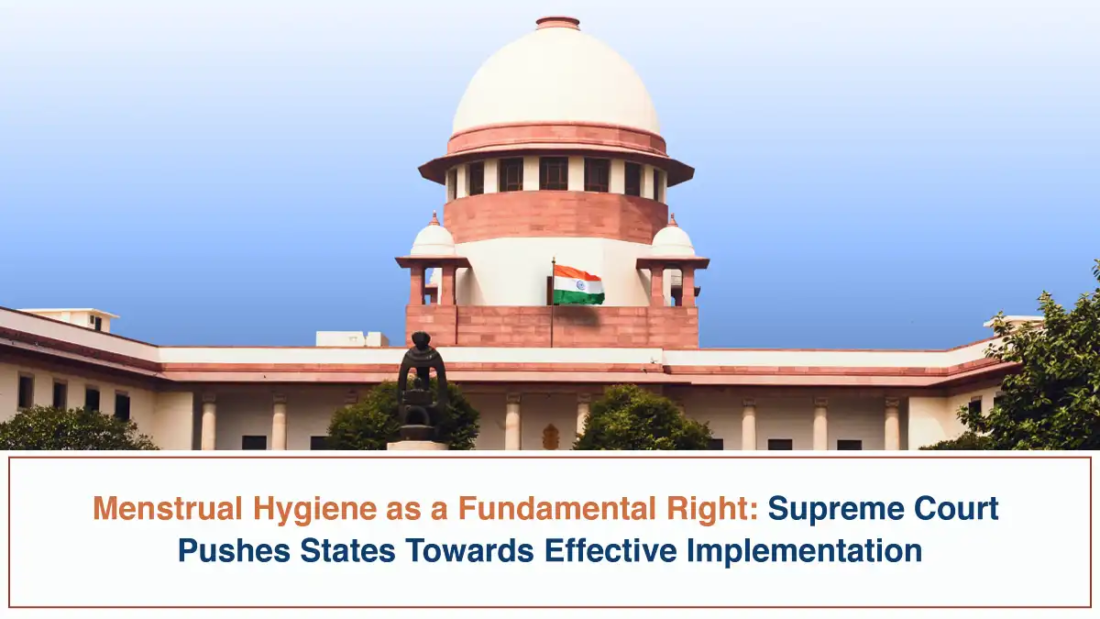
The Supreme Court expressed concern that, despite its earlier declaration recognising menstrual hygiene and menstrual health as facets of Article 21, governmental inaction could leave the right without effective implementation. The Court stressed that recognising a fundamental right through a judicial pronouncement is insufficient unless the Union, States and Union Territories take concrete steps to give effect to it.
The Court highlighted the educational consequences of inadequate menstrual hygiene, particularly for girls in remote parts of the country. Its observations underscored the need for governments to translate the constitutional recognition of menstrual health into measurable administrative action rather than allowing the judgment to remain merely declaratory.
The Court was also critical of the failure of States and Union Territories to respond to the Union Government’s requests for information. It observed that the Union had raised the issue seriously, yet the lack of responses prevented the Court from assessing the progress made towards implementing the earlier judgment.
To address this deficiency, the Court directed the Union to study the 1 September 2026 judgment again, paying particular attention to paragraphs 11 and 13 to 23. It required the Union to obtain written information from each State and Union Territory regarding the measures taken to comply with the judgment.
The Court further indicated that a structured reporting mechanism would improve accountability. It permitted the Union to prepare a questionnaire covering the relevant aspects of the earlier directions and seek specific responses from every State and Union Territory.
Order of the Court
The Supreme Court directed the Union Government to pursue implementation seriously and obtain written reports from the States and Union Territories. It granted one final opportunity for compliance and warned that, if any State or Union Territory failed to respond by the next hearing, the Court could issue contempt notices to the concerned Chief Secretary. The matter was listed for further hearing on 14 December 2026 at 2:30 p.m.
Key Takeaway
The recognition of menstrual hygiene and menstrual health as facets of Article 21 carries an obligation to pursue effective implementation. Government authorities must take concrete steps, provide information on compliance and respond to judicial directions. The Supreme Court’s order demonstrates its willingness to use structured reporting and potential contempt proceedings to ensure that fundamental rights are implemented in practice, particularly where inadequate menstrual hygiene affects girls’ access to education.
Written by Adv. K. Sri Hamsa