 Cart is empty

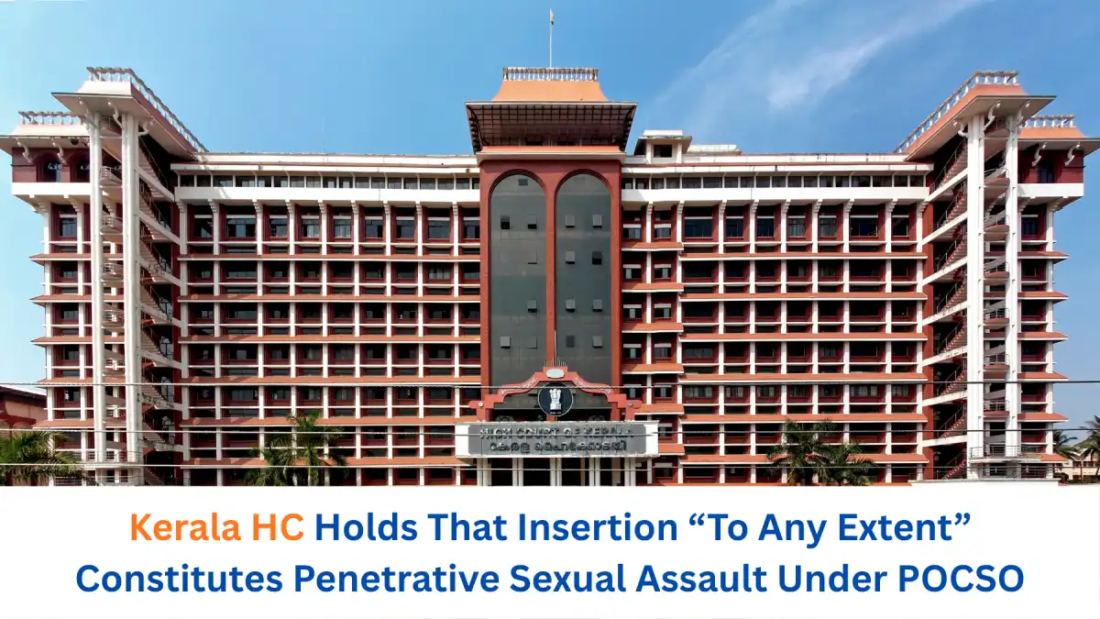
Case Name: Joshy K.J. v. State of Kerala
Factual Background
The appellant, Joshy K.J., challenged his conviction by the Special Court under the POCSO Act, Perumbavoor. He had been convicted under Section 4(1) read with Section 3(b) of the POCSO Act, as well as Sections 376(1) read with 375(b), 354B and 506(i) of the IPC. For the POCSO offence, he was sentenced to 10 years’ rigorous imprisonment and a fine of ₹20,000, with the substantive sentences directed to run concurrently.
The prosecution alleged that the appellant, while working as a make-up man at an establishment operated by the second accused, took the minor victim into a treatment room. He allegedly forced her onto a treatment bed, removed part of her clothing and used a vibrating machine fitted with a penis-like structure on her vagina. According to the victim, the machine was pressed against her private parts and caused severe pain. She was also allegedly threatened with social humiliation if she disclosed the incident.
The appellant challenged the conviction on several grounds, including the approximately two-year delay in lodging the FIR, the victim’s age, inconsistencies in her statements, absence of medical/scientific corroboration and the alleged failure of the prosecution to establish the occurrence beyond reasonable doubt.
Court’s Analysis
The High Court first rejected the appellant’s argument concerning the victim’s age. Documentary evidence established that her date of birth was 11 January 2002. She was therefore below 18 years of age on the date of the incident and was a “child” within the meaning of Section 2(1)(d) of the POCSO Act. The fact that she was 17 years and five months old did not alter her statutory status.
The Court then examined the victim’s testimony. Although there were certain omissions and discrepancies between her earlier statements and evidence before the Court, the High Court found that her core account of the sexual assault remained intact. The victim identified the
vibrating machine and the penis-like attachment, both of which had been recovered during the investigation.
The central question concerned the scope of Section 3(b) of the POCSO Act, which defines penetrative sexual assault to include insertion, “to any extent,” of any object or part of the body other than the penis into the vagina, urethra or anus of a child. The Court emphasised the statutory expression “to any extent”. It held that placing the vibrating machine fitted with the penis-like structure on the vaginal opening, including the labia majora or vulva, was sufficient to constitute insertion for the purposes of Section 3(b).
The Court also rejected the challenge based on delayed reporting. It accepted the explanation that the minor victim had been threatened and was afraid of the accused persons. The Court consequently found the delay adequately explained and held that it did not undermine the prosecution case.
Order of the Court
The Kerala High Court dismissed the criminal appeal and confirmed the conviction and sentence imposed by the Special Court. The Court upheld the conviction under Section 3(b) read with Section 4(1) of the POCSO Act, as well as the convictions under Sections 354B and 506(i) of the IPC.
The Court declined to reduce the sentence because 10 years’ rigorous imprisonment was the statutory minimum prescribed for the offence under Section 3(b) read with Section 4(1) of the POCSO Act. The appeal was accordingly dismissed.
Key Takeaway
The judgment provides an important interpretation of “penetrative sexual assault” under Section 3(b) of the POCSO Act. The Court emphasised that the statutory requirement is insertion “to any extent” and therefore does not require extensive or complete penetration. On the facts of the case, placing the vibrating instrument at the vaginal opening was sufficient to satisfy the statutory requirement.
The judgment also demonstrates that delayed disclosure and minor inconsistencies in a child victim’s testimony do not, by themselves, invalidate the prosecution case, particularly where
the core account remains consistent and is supported by surrounding evidence. The decision is particularly relevant when distinguishing the threshold for penetrative sexual assault under Section 3 from non-penetrative sexual assault under Section 7 of the POCSO Act.
Written by Adv. K. Sri Hamsa