 Cart is empty

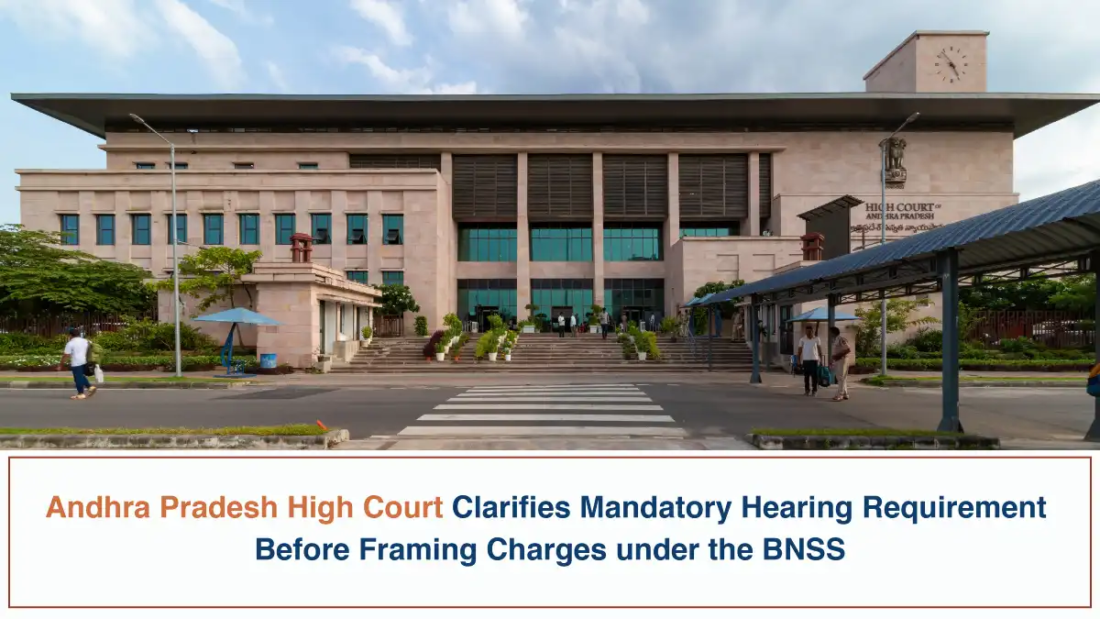
Case Name: Shaik Shahina & Anr. v. State of Andhra Pradesh
Factual Background
The petitioners, arraigned as Accused Nos. 2 and 3 in a prosecution under the Protection of Children from Sexual Offences Act, 2012 (POCSO Act), the Bharatiya Nyaya Sanhita, 2023 (BNS), and the Immoral Traffic (Prevention) Act, challenged an order of the Special POCSO Court framing charges against them. They contended that the Trial Court had proceeded to frame charges without granting them an effective opportunity of hearing under Section 251(2) of the Bharatiya Nagarik Suraksha Sanhita, 2023 (BNSS). It was argued that the Investigating Officer had initially found no incriminating material against them and that their implication rested solely upon a supplementary statement of the complainant recorded after a considerable delay. The petitioners further submitted that the statutory right to seek discharge under Section 250 BNSS had effectively been denied because the Trial Court framed charges before affording a meaningful hearing. The prosecution opposed the revision by contending that sufficient prima facie material existed against the petitioners and that the Trial Court had acted in conformity with the objective of expeditious disposal under Section 35 of the POCSO Act. The victim’s counsel also questioned the maintainability of the revision, arguing that the petitioners had neither filed a discharge application nor indicated any intention to do so before the Trial Court.
Court’s Analysis
The Andhra Pradesh High Court undertook a detailed examination of the newly enacted procedural framework under the BNSS and its interaction with the special procedure prescribed under the POCSO Act. Referring to several Supreme Court decisions, including Madhu Limaye, Amar Nath, Asian Resurfacing of Road Agency Pvt. Ltd., and Sanjay Kumar Rai, the Court reiterated that although interference with orders framing charges should be exercised sparingly, revisional jurisdiction remains available where procedural safeguards are violated. The Court analysed Sections 250 and 251 BNSS and observed that the legislature had introduced a sixty-day period for filing discharge applications, thereby conferring a valuable statutory right upon the accused. Recognising that Special Courts under the POCSO Act take direct cognisance without committal proceedings, the Court resolved the resulting legislative gap by holding that the sixty-day period should be computed from the date on which the accused receives copies of the police papers under Section 230 BNSS. More importantly, the Court found that the Trial Court’s docket failed to demonstrate that an effective hearing had been afforded before framing charges as required under Section 251(2). The absence of such hearing deprived the petitioners of an important statutory safeguard and justified interference in revisional jurisdiction despite the overarching objective of ensuring speedy POCSO trials.
Order of the Court
The High Court allowed the revision and set aside the order framing charges. It granted the petitioners fifteen days to file discharge applications and directed the Trial Court to decide such applications after hearing both sides within two weeks. In the event discharge was refused, the Trial Court was directed to provide a fresh hearing before framing charges and thereafter proceed with the trial expeditiously in accordance with the POCSO Act.
Key Takeaway
The judgment harmonises the procedural safeguards introduced under the BNSS with the expeditious trial requirements of the POCSO Act. It affirms that speedy criminal trials cannot override the accused’s statutory right to seek discharge and to receive an effective hearing before charges are framed. The decision is likely to serve as an important precedent governing the procedure to be followed by Special Courts constituted under the POCSO Act.
Written by Adv. K. Sri Hamsa