 Cart is empty

Factual Background
The appellant, a professor, challenged his conviction under Sections 376(2)(f) and 506 of the Indian Penal Code and Section 6 of the Protection of Children from Sexual Offences Act, 2012. The prosecution alleged that a minor girl had been placed in the appellant’s care for educational purposes by her father. It was alleged that during her stay with him, the appellant repeatedly subjected her to sexual intercourse, administered medicines to her, threatened her against disclosure, and exercised control over her movements. The victim eventually informed her elder sister, who rescued her and lodged a complaint. Following investigation, the appellant was convicted by the Special POCSO Court and sentenced to twenty years’ imprisonment. The conviction was challenged before the Calcutta High Court on grounds including inconsistencies in the prosecution evidence, investigative deficiencies, lack of corroboration, and alleged false implication arising from matrimonial disputes involving the appellant’s estranged wife.
Court’s Analysis
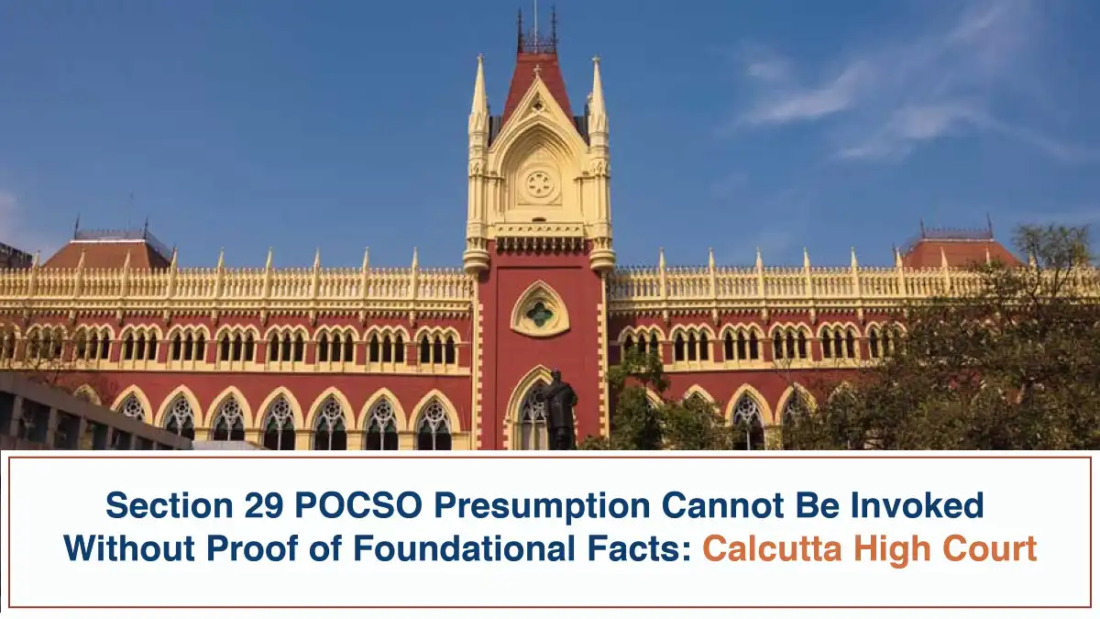
The High Court examined the scope and application of Section 29 of the POCSO Act, which creates a statutory presumption against the accused once foundational facts are established by the prosecution. Referring to recent Supreme Court precedents, the Court reiterated that the presumption under Section 29 is not automatic and cannot be invoked merely because allegations have been made. The prosecution must first establish foundational facts through reliable, cogent, and legally admissible evidence. The Court carefully scrutinised witness testimony, medical evidence, seizure procedures, investigative omissions, and inconsistencies regarding the dates and circumstances of the alleged assaults. The Court criticised the Trial Court for invoking the statutory presumption without first undertaking a detailed assessment of whether the foundational facts necessary for its application had been satisfactorily proved. The judgment emphasised that courts must independently evaluate the credibility of prosecution evidence and cannot mechanically rely upon statutory presumptions.
Order of the Court
The High Court conducted a comprehensive reassessment of the evidence and examined whether the prosecution had discharged its initial burden before the statutory presumption under Section 29 could be applied. The Court stressed the importance of maintaining fairness in POCSO prosecutions and ensuring that presumptions do not replace judicial scrutiny of evidence.
Key Takeaway
The judgment serves as an important clarification of the evidentiary framework under the POCSO Act. It reinforces that the statutory presumption under Section 29 arises only after the prosecution establishes foundational facts through credible evidence. The decision underscores the continued importance of rigorous judicial scrutiny, even in cases involving special statutory presumptions intended to protect child victims.
Written by Adv. K. Sri Hamsa