 Cart is empty


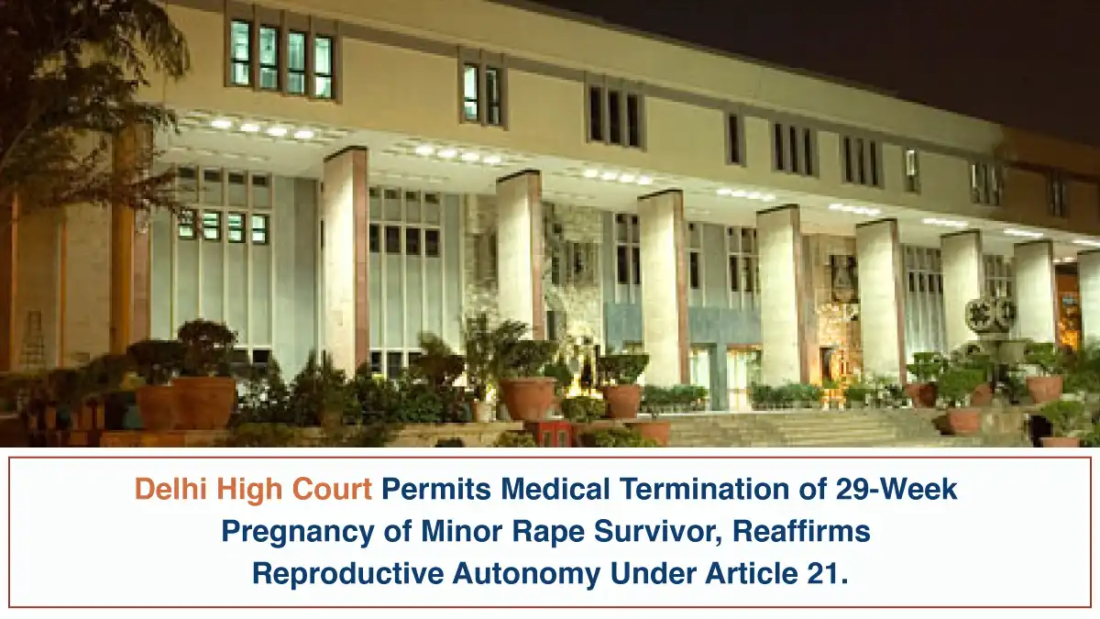
Case Name: Minor V through Grandmother M v. State of NCT of Delhi & Anr.
Factual Background
The present writ petition was filed on behalf of a minor girl, ‘V’, through her grandmother, under Article 226 read with Article 21 of the Constitution of India and Section 528 of the Bharatiya Nagarik Suraksha Sanhita, 2023. The petitioner sought permission for medical termination of pregnancy under Section 3(2) of the Medical Termination of Pregnancy Act, 1971 (MTP Act).
The petitioner, approximately 17 years of age, was a survivor of rape and was carrying a pregnancy conceived as a consequence of the incident. At the time of approaching the Court, she was approximately 29 weeks pregnant and had been admitted to Deen Dayal Upadhyay Hospital, New Delhi, for medical care and supervision. An FIR had already been registered at Police Station Khyala, Delhi, in relation to the incident. Both the minor and her grandmother expressed their desire to terminate the pregnancy, stating that its continuation would cause grave mental injury and psychological trauma to the minor, considering her age and the circumstances in which the pregnancy had arisen.
Since the pregnancy had crossed the statutory gestational limit of 24 weeks, the petitioner sought the Court’s intervention. The Medical Board constituted at Deen Dayal Upadhyay Hospital examined the petitioner and submitted its report, concluding that she was medically and psychologically fit to undergo the termination procedure.
Court’s Analysis
The Court examined whether medical termination could be permitted beyond the statutory period of 24 weeks, particularly where the pregnancy involved a minor survivor of rape. It considered the Supreme Court’s decision in S. v. Union of India & Ors., 2026 INSC 446, wherein termination was permitted at 28 weeks of gestation. The Supreme Court had recognised that constitutional courts exercising jurisdiction under Articles 226 and 32 are not confined by the statutory gestational limits under the MTP Act while considering the constitutional rights and welfare of a pregnant woman.
The Court reiterated that reproductive choice forms an integral part of the right to personal liberty, privacy and bodily autonomy under Article 21. A woman, particularly a minor survivor of rape, cannot be compelled to continue an unwanted pregnancy merely because the statutory gestational limit has been crossed. The welfare, dignity, bodily integrity and reproductive autonomy of the pregnant woman must remain central to the Court’s assessment.
Applying these principles, the Court observed that the question of termination cannot be decided solely by reference to the statutory gestational limit. The circumstances of each case, including the age of the pregnant woman, the circumstances in which the pregnancy arose, the medical opinion and the rights and interests of the pregnant woman, must be considered. In the present case, the minor’s age, the fact that the pregnancy resulted from rape, her expressed wish to terminate it and the favourable Medical Board report supported the relief sought.
Order of the Court
The Delhi High Court allowed the writ petition and permitted medical termination of the minor’s pregnancy, subject to specific safeguards. The procedure was directed to be conducted by a competent team of doctors in accordance with the MTP Act and the applicable Rules, Regulations and Guidelines. The Medical Board was directed to maintain the complete medical record of the procedure.
The hospital was further directed to preserve the foetal tissue for DNA testing in connection with the registered criminal case. The State was ordered to bear all expenses relating to the termination, hospital stay and post-operative care. In the event of a live birth, the hospital and State authorities were required to provide all feasible medical support, including incubator care, and inform the concerned Child Welfare Committee. Adoption could be pursued in accordance with the prescribed procedure and the wishes of the minor and her family. The Court also directed strict protection of the survivor’s identity and prohibited disclosure of particulars capable of identifying her, except where authorised or required by law.
Written by Adv. K. Sri Hamsa