 Cart is empty


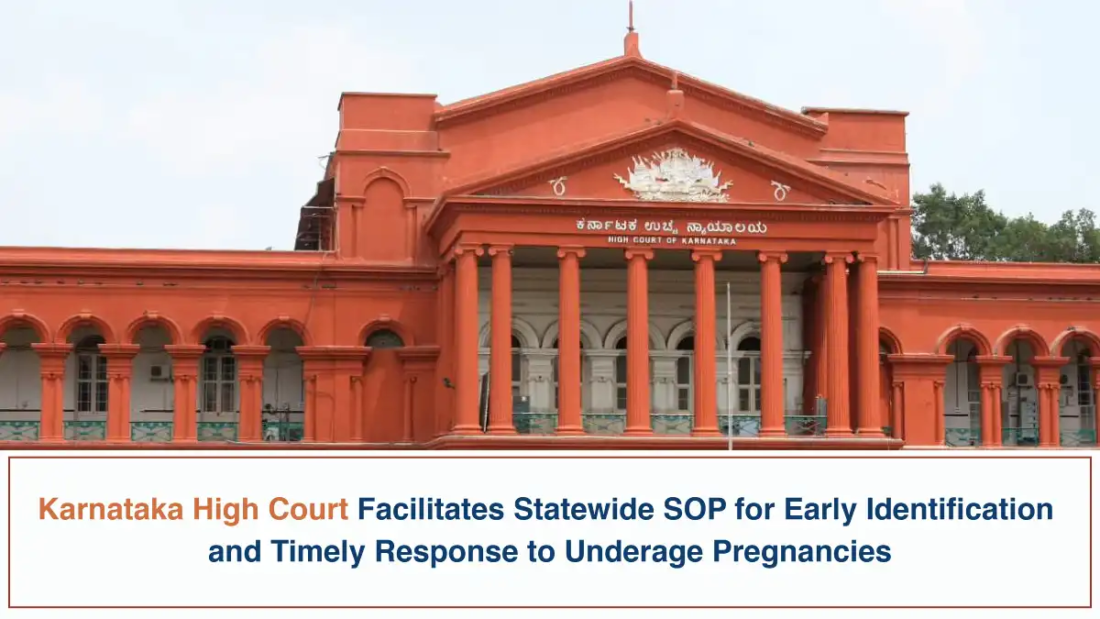
The Karnataka High Court has facilitated a statewide SOP for underage pregnancies, setting out how police, medical, child protection and legal services authorities should identify and respond to such cases early. The SOP took shape in proceedings that began as a minor’s petition for medical termination of pregnancy.
Case Name: X v. State of Karnataka
Factual Background
The petitioner, a 16-year-old girl represented by her mother, approached the Karnataka High Court under Article 226 of the Constitution of India seeking medical termination of pregnancy. The petitioner was a student in Standard IX and had become pregnant following sexual assault. She had been unable to disclose the incident to her mother because of the circumstances surrounding the assault, and the pregnancy was detected only at an advanced stage. Her mother, a single parent working as a housemaid and belonging to a financially disadvantaged background, supported her request for termination.
The petitioner asserted that the continued pregnancy would make her relive the trauma of sexual assault and adversely affect her mental health. She invoked her rights to life, reproductive freedom, bodily autonomy, privacy and liberty under Article 21 of the Constitution.
The Court had earlier permitted termination, subject to medical opinion. The subsequent report indicated that the foetus had survived the procedure, and the child-mother did not wish to retain custody of the baby. The circumstances brought to the forefront concerns regarding late detection of pregnancies among minors, delays in accessing lawful termination services, and the care and protection of an infant born alive following the procedure.
The proceedings consequently expanded beyond the individual petition. The Court sought the participation of the State, the petitioner and an amicus curiae to formulate a Standard Operating Procedure (SOP) for the early identification of underage pregnancies and timely intervention.
Court’s Analysis and the SOP for Underage Pregnancies
Justice S. Sunil Dutt Yadav recognised that delayed disclosure of sexual assault and pregnancy may arise from fear of social stigma, inadequate awareness of legal rights, misconceptions about contraception and termination, and difficulties in accessing medical services. Such delays can place minor victims at additional physical and psychological risk.
The Court emphasised the limitations of relying exclusively on judicial directions to address recurring social problems. It observed that effective implementation depends on the involvement and cooperation of the executive authorities responsible for administering public services. Accordingly, it adopted a consultative approach, involving the petitioner, the amicus curiae and the State Government in developing an appropriate response.
Following discussions and consideration of the parties’ suggestions, the State prepared a draft SOP for early identification and timely response to underage pregnancies. The framework covered coordination among police authorities, registered medical practitioners, medical boards, Child Welfare Committees (CWCs), District Child Protection Units (DCPUs), child-care institutions and legal services authorities.
The SOP addresses early identification, access to appropriate medical care and lawful pregnancy termination, counselling and support, privacy and dignity, and arrangements for the care and adoption of a child born alive following a termination procedure. It also provides for training of relevant personnel, monitoring of implementation, review mechanisms and grievance redressal. Its stated scope extends throughout Karnataka.
Order of the Court
The State informed the Court that the SOP had been finalised and gazetted on 31 July 2026. In view of its formal notification, the Court concluded that no further adjudication was necessary and disposed of the matter. The final proceeding therefore culminated in a statewide administrative framework addressing the systemic issues identified during the original pregnancy-termination proceedings.
In effect, the SOP for underage pregnancies now offers a gazetted, statewide framework for early identification and timely response, rather than relying only on case-by-case judicial directions.
Written by Adv. K. Sri Hamsa
Related reading: