 Cart is empty

Case Name: In Re: Recent Rape Incidents in Delhi NCR
Factual Background
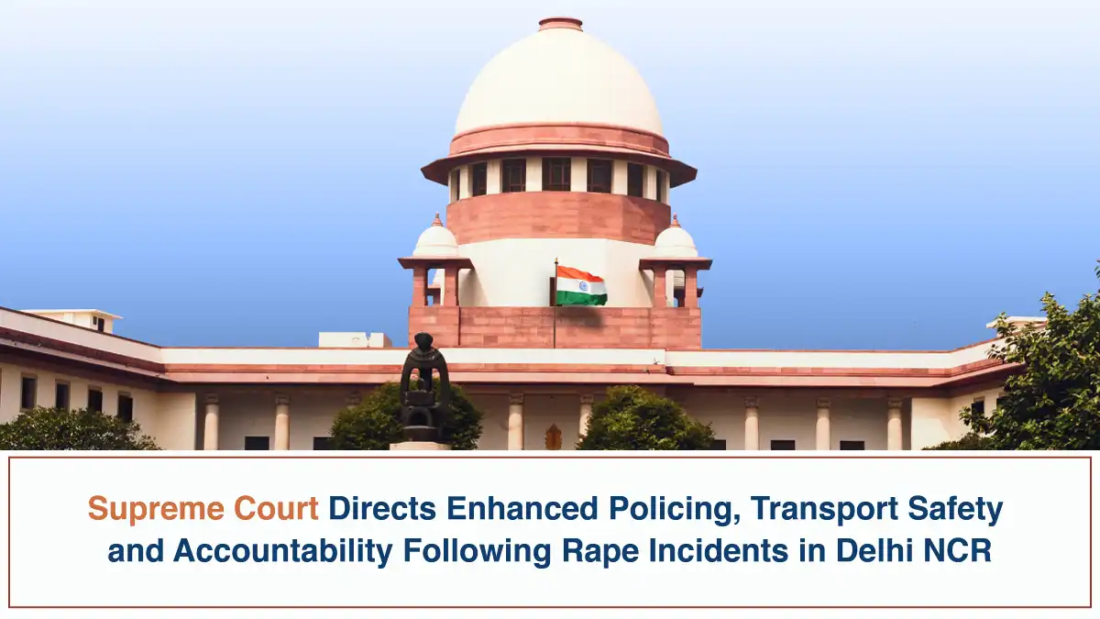
The Supreme Court initiated suo motu proceedings on 28 September 2026 in response to recent rape incidents in Delhi NCR, focusing on shortcomings in the prevention of sexual offences, emergency response mechanisms and public-safety infrastructure.
During the proceedings, the Court heard submissions from the learned amicus curiae regarding inadequate police patrolling, the need to assess the functioning of dedicated anti-eve-teasing squads and the shortage of police personnel. Reference was made to Delhi Police Circular No. 15/2025 dated 8 March 2025, which established district-wise She Squads, and Standing Order No. L&O/25/2024, titled “Action Against Sexual Offences in Public.”
The amicus also highlighted difficulties faced by citizens in reporting public-safety concerns because multiple grievance-redressal portals operate independently. Deficiencies in street lighting, CCTV coverage and patrol monitoring were identified as issues requiring urgent intervention. The Union Government informed the Court that officials from the Delhi Government, Delhi Police, municipal bodies and the Ministry of Women and Child Development had begun joint deliberations regarding compliance with the Court’s earlier directions.
Court’s Analysis
The Supreme Court emphasised that public safety cannot be limited to responding to crimes after their commission. Effective prevention requires sustained police visibility, surveillance, rapid emergency intervention and prompt correction of identifiable vulnerabilities.
The Court referred to the “Broken Windows” theory to explain how visible neglect, including broken streetlights, non-functional CCTV cameras and unaddressed public complaints, can contribute to perceptions of insecurity and inadequate law enforcement. Such deficiencies must be addressed before they facilitate criminal activity.
The Court observed that existing circulars and standing orders already provided for several preventive measures, including She Squads and initiatives encouraging school- and college-going girls to report sexual offences. However, the recurrence of incidents raised concerns regarding implementation, supervision and accountability. The effectiveness of preventive policing must therefore be assessed through demonstrable action on the ground rather than the mere existence of administrative protocols.
The Court further recognised the importance of accessible grievance-redressal mechanisms and meaningful citizen participation. Preventive policing should be institutionalised through regular training, identifiable responsibility, monitored patrolling and mechanisms ensuring that complaints are promptly acted upon. At the same time, police intervention must remain lawful, proportionate and accountable.
Order of the Court
The Supreme Court directed immediate enhancement of beat patrolling across Delhi NCR, particularly around educational institutions and areas identified as vulnerable. It ordered strict verification of drivers and assistants operating public transport vehicles, including private buses, taxis, auto-rickshaws and app-based services. Verified personnel must be identifiable to passengers, and unauthorised substitution or subletting to unverified drivers is prohibited.
The Court also directed authorities to assess the integration of vehicle-tracking systems with emergency response mechanisms, communicate SOS procedures and response protocols to passengers, remove vehicles creating safety-related blind spots, and take action against unauthorised liquor establishments.
The Commissioner of Police, Delhi, must submit the previous three months’ weekly reports concerning She Squads, together with a consolidated implementation report. A status report on Operation Nirbheek and the Nazuk Scheme must address complainant protection, confidentiality and safeguards against retaliation. The specialised training modules for the squads must also be examined. Comprehensive compliance reports were directed to be filed by 6 November 2026, and the matter was listed for 16 November 2026. The proceedings remain pending.
Written by Adv. K. Sri Hamsa