 Cart is empty

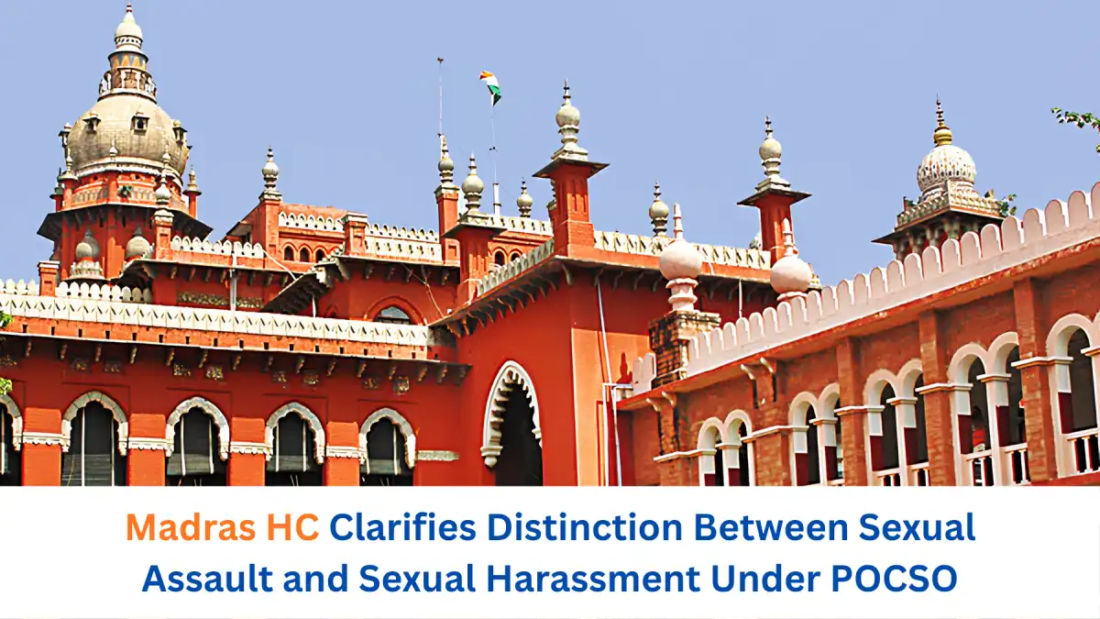
Case Name: Mandai @ Manogaran v. State
Factual Background
The petitioner, Mandai @ Manogaran, was convicted by the Special Court for Exclusive Trial of POCSO Cases, Chennai under Section 8 of the Protection of Children from Sexual Offences Act, 2012 (POCSO Act) and sentenced to three years’ rigorous imprisonment along with a fine of ₹1,000. He approached the Madras High Court seeking suspension of his sentence pending disposal of his criminal appeal.
The prosecution alleged that on 1 March 2020, the petitioner, who lived in the same compound as the minor victim, whistled at her from his balcony and called her. When she did not respond, he came downstairs, pulled her by the hand and smiled at her with sexual intent. The victim subsequently informed her mother. The petitioner disputed the allegations and contended that the case was falsely instituted following a physical altercation between him and the victim’s father.
The petitioner argued that the evidence only established that he had pulled the victim’s hand and that the act did not constitute sexual assault. According to him, the conduct could, at most, amount to sexual harassment under Section 11 of the POCSO Act, rather than sexual assault under Section 7.
Court’s Analysis
The High Court examined the material on record and noted that the victim was the only witness to the actual occurrence. Her evidence established that the petitioner whistled at her, called her and, when she did not respond, came down and pulled her by the hand. She then freed herself and informed her mother.
The Court observed that the act attributed to the petitioner could not straightaway be characterised as having been committed with sexual intent. On the facts available, the Court considered that the conduct could, at most, be regarded as harassment rather than an act of
sexual assault. It consequently found that the petitioner had raised arguable grounds in the pending appeal concerning the correctness of the conviction.
The Court was considering an application for suspension of sentence and not finally determining the criminal appeal. Therefore, its observations were made in the context of determining whether there were arguable grounds warranting suspension of the sentence.
Order of the Court
The Madras High Court suspended the substantive sentence imposed upon the petitioner until disposal of the criminal appeal. The petitioner was ordered to be released on bail upon executing a bond of ₹5,000 with two sureties for a like amount to the satisfaction of the trial court.
The Court further directed the petitioner to appear before the trial court once every three months, on the first working day at 10:30 a.m., until the criminal appeal was disposed of.
Key Takeaway
The case highlights the importance of sexual intent in distinguishing sexual assault under Section 7 of the POCSO Act from sexual harassment under Section 11. The Court observed that merely pulling a minor’s hand, in the circumstances presented, could not automatically be treated as an act of sexual assault without sufficient indication of sexual intent. Since the Court was deciding an application for suspension of sentence, rather than the appeal itself, the observation should be understood as identifying an arguable issue for reconsideration and not as a final determination that the petitioner was not guilty of sexual assault.
Written by Adv. K. Sri Hamsa