 Cart is empty

Factual Background
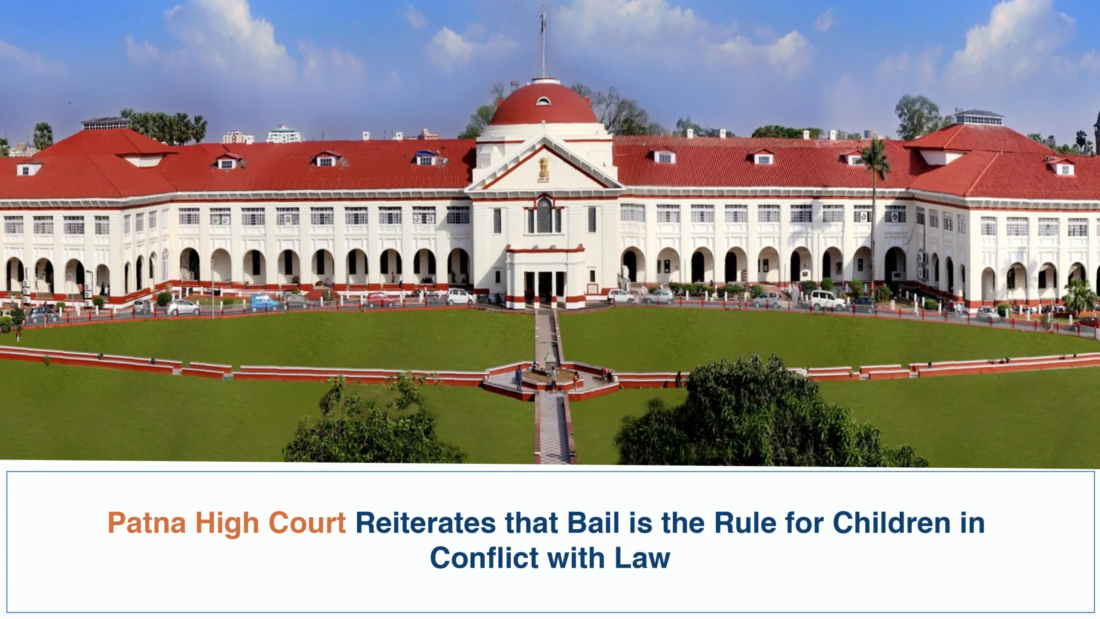
The Patna High Court, in XXX v. State of Bihar, considered an appeal against an order rejecting the bail application of a child in conflict with law accused of offences under Sections 103(1) and 61(2) of the Bharatiya Nyaya Sanhita, 2023 and Section 27 of the Arms Act. The prosecution alleged that the appellant was involved in a murder along with co-accused persons and that his name surfaced through the confessional statement of a co-accused and CCTV footage. The Children Court had declined bail after relying on the Social Investigation Report, which indicated that the appellant had dropped out of school, associated with persons having criminal backgrounds, had previous criminal antecedents, suffered from substance abuse, and lacked adequate parental supervision, as his parents resided outside Bihar. The appellant challenged the order, contending that the statutory grounds for refusing bail under Section 12 of the Juvenile Justice (Care and Protection of Children) Act, 2015 (“JJ Act”) were not attracted.
Court’s Analysis
The High Court undertook an extensive examination of Section 12 of the JJ Act and reiterated that the provision creates a statutory presumption in favour of granting bail to every child in conflict with law, irrespective of whether the alleged offence is bailable, non-bailable, or even heinous. The Court observed that refusal of bail is permissible only where there are reasonable grounds to believe that the child’s release is likely to bring them into association with known criminals, expose them to moral, physical, or psychological danger, or defeat the ends of justice. Relying upon several decisions of the Supreme Court and various High Courts, the Court clarified that the gravity of the offence, the severity of punishment, or the fact that the child may be tried as an adult cannot, by themselves, justify denial of bail. It further emphasised that the expression “ends of justice” under the JJ Act must be interpreted in light of the Act’s rehabilitative object rather than traditional criminal jurisprudence. The Court also highlighted that institutionalisation is intended to be a measure of last resort and that Social Investigation Reports play a crucial role in assessing the child’s welfare and prospects of rehabilitation.
Applying these principles, however, the Court found that the present case fell within the statutory exceptions. The Social Investigation Report revealed that the appellant had prior criminal antecedents, maintained associations with known criminals, was addicted to intoxicants, lacked a stable family environment, and had no effective parental supervision. The Court concluded that continued placement in an Observation Home would better serve the appellant’s rehabilitation and welfare than his release on bail.
Order of the Court
The Patna High Court dismissed the appeal and upheld the order refusing bail. At the same time, recognising the importance of expeditious proceedings involving children, the Court directed the Children Court to conclude the trial as far as possible within nine months after ensuring the prompt examination of prosecution witnesses.
Key Takeaway
The judgment reinforces that Section 12 of the JJ Act establishes bail as the norm for children in conflict with law, regardless of the seriousness of the alleged offence. Nevertheless, courts may refuse bail where credible material demonstrates that release would expose the child to criminal influence, psychological or physical harm, or otherwise impede their rehabilitation. The decision underscores that while the juvenile justice system prioritises reform over punishment, the child’s best interests remain the paramount consideration in determining whether continued institutional care is warranted.
Written by Adv. K. Sri Hamsa