 Cart is empty

Factual Background
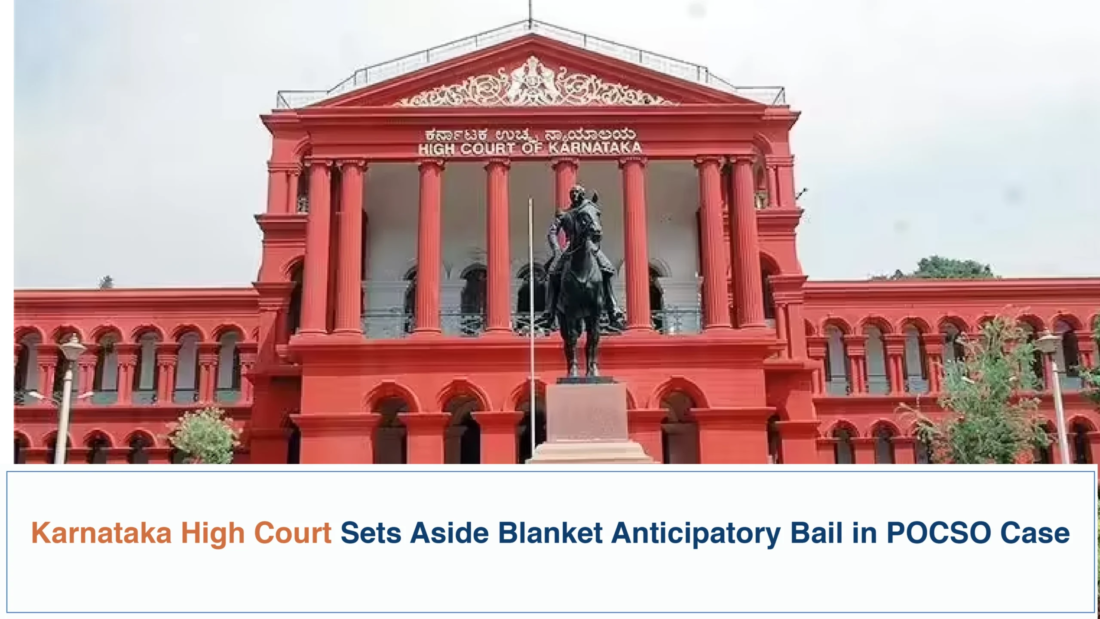
The Karnataka High Court, in Smt. Rekha v. State by Harihara Rural Police & Another, examined the legality of an anticipatory bail order granted to the second respondent, a religious leader, in anticipation of allegations under the Protection of Children from Sexual Offences Act, 2012 (“POCSO Act”). The respondent had approached the Sessions Court before the registration of any First Information Report (FIR), claiming that he apprehended false implication due to an ongoing dispute with the trustees of a religious institution. Accepting this contention, the Sessions Court granted him anticipatory bail not only in respect of any future complaint by the petitioner, but also in relation to any complaint that might subsequently be lodged by trustees, followers, children, or their parents alleging offences under the POCSO Act. Aggrieved by the breadth of the relief granted, the complainant approached the High Court seeking cancellation of the anticipatory bail on the ground that it amounted to an impermissible blanket protection in cases involving grave offences against children.
Court’s Analysis
The High Court held that the Sessions Court had failed to exercise its discretion in accordance with settled principles governing anticipatory bail. Relying upon the Supreme Court’s decisions in Sumitha Pradeep v. Arun Kumar C.K., X v. State of Maharashtra, Sushila Aggarwal v. State (NCT of Delhi) and other precedents, the Court reiterated that while registration of an FIR is not invariably a prerequisite for seeking anticipatory bail, such relief cannot be granted mechanically or in the form of a blanket order covering every conceivable future complaint. The Court observed that in offences under the POCSO Act, the primary consideration must be whether a prima facie case exists, the seriousness of the allegations, the legislative intent underlying the statute, and the possibility of influencing witnesses or obstructing the investigation.
The Court criticised the Sessions Court for granting protection based largely on newspaper reports and social media posts suggesting that false allegations might be made, without examining the gravity of the alleged offences or the statutory safeguards contained in the POCSO Act. It further emphasised that an order of anticipatory bail must remain confined to a specific incident giving rise to a reasonable apprehension of arrest and cannot extend to unknown future complaints. The High Court also reiterated the Supreme Court’s recognition of a victim’s right to participate in bail proceedings, observing that victims of serious sexual offences are entitled to be heard before courts decide applications that may substantially affect the investigation and administration of justice.
Order of the Court
The Karnataka High Court set aside the order granting anticipatory bail, holding that the Sessions Court had committed a serious error in granting an unrestricted and blanket anticipatory bail in relation to future complaints under the POCSO Act. The Court concluded that the impugned order was contrary to settled legal principles governing anticipatory bail and could not be sustained.
Key Takeaway
The decision reinforces that anticipatory bail is a discretionary remedy that must be exercised cautiously, particularly in cases involving allegations under the POCSO Act. Courts cannot grant blanket protection against unspecified future complaints merely based on an apprehension of false implication. The judgment also reiterates that the gravity of offences against children, the existence of a prima facie case, and the victim’s right to be heard are central considerations while deciding anticipatory bail applications, thereby ensuring that the interests of justice and child protection remain paramount.
Written by Adv. K. Sri Hamsa