 Cart is empty

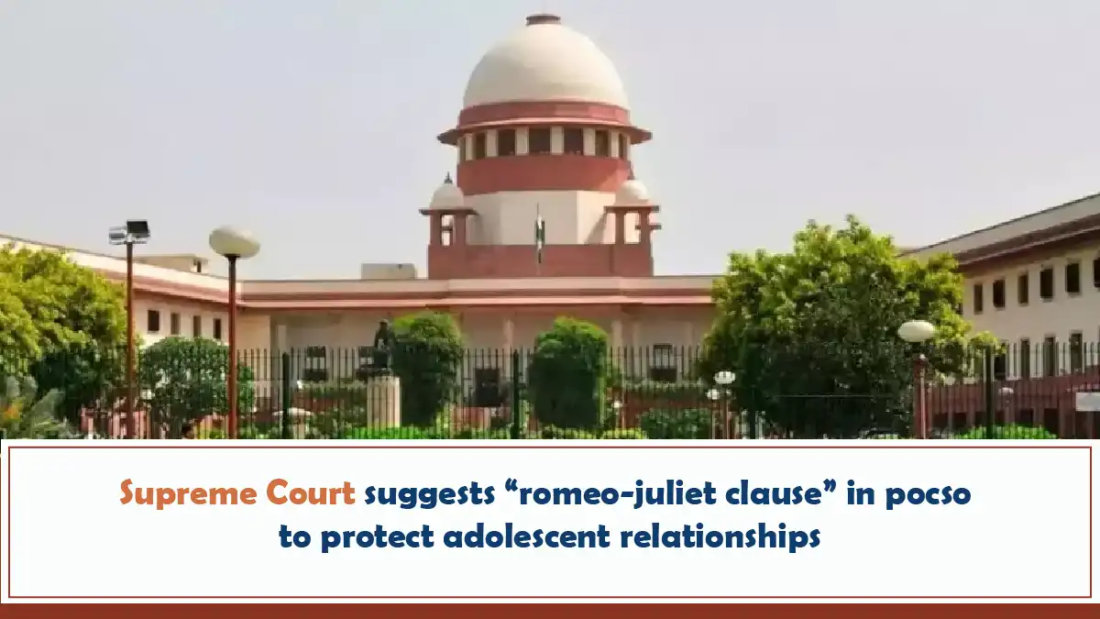
The Supreme Court of India has taken a thoughtful and progressive stance on the application of the Protection of Children from Sexual Offences Act, 2012 (“POCSO Act”), urging the Union Government to consider introducing a “Romeo-Juliet clause” to the law. This observation was made during the hearing of an appeal against an Allahabad High Court order concerning bail in a POCSO matter, but the implications extend far beyond the procedural dispute before the Court.
The POCSO Act was enacted with a noble objective: to provide robust legal protection to children from sexual abuse and exploitation. Under the Act, any sexual activity involving a person under the age of 18 is criminalised, irrespective of consent, classification, or context. While this legislative design is rooted in child protection principles, it has also resulted in the criminalisation of consensual relationships between adolescents, particularly where the age difference is small and the encounter voluntary.
The Supreme Court, in a ruling delivered by a Bench comprising Justices Sanjay Karol and N. Kotiswar Singh, expressed grave concern over the misuse of POCSO in cases where teenagers in consensual relationships are prosecuted under its stringent provisions. The Court noted that parents or families, disapproving of adolescent relationships, have sometimes resorted to invoking POCSO to “settle personal scores”, leading to unnecessary criminal liability for the young parties involved.
What Is the Romeo-Juliet Clause?
The term “Romeo-Juliet clause” refers to a specific legal exemption that shields consensual sexual activity between minors (or between a minor and a slightly older person) from criminal prosecution provided certain age gap criteria are met. The name derives from Shakespeare’s iconic young lovers, Romeo and Juliet, and has been incorporated in various jurisdictions, notably several U.S. states, to prevent consensual adolescent interactions from being treated as statutory rape.
Under such a clause, consensual relations between teenagers with a close age gap (for example, where the age difference is within a narrow range such as 2 – 5 years) would not attract criminal liability under statutory rape provisions. In practice, this clause recognises that adolescents can engage in consensual, non-exploitative relationships, and that subjective application of strict age-based rules can sometimes penalise normal adolescent behaviour.
The Supreme Court emphasised that while it is imperative to protect children from sexual abuse, the law should not criminalise situations where both parties are minors and the relationship is consensual. To this end, the Court directed that its judgment be communicated to the Secretary, Ministry of Law and Justice to consider initiating steps towards framing a legal exemption, inclusive of a Romeo-Juliet clause, that would safeguard such relationships from the full force of the POCSO Act.
Balancing Protection with Rational Application
In its observations, the Supreme Court also set aside the Allahabad High Court’s direction mandating mandatory medical age determination in all POCSO cases at the bail stage, noting that age determination is a matter for trial and not for bail proceedings. This underscores the Court’s concern that hybrid procedural innovations might distort statutory intent or lead to unnecessary prosecution of consensual adolescent behaviour.
The Court acknowledged that POCSO’s purpose is “one of the most solemn articulations of justice aimed at protecting the children of today and the leaders of tomorrow”, but remarked that laws of good intent can be misused when they lack contextual flexibility. It observed that misuse of the law reflects deeper societal challenges including stigma around adolescent relationships, social control, and misuse of criminal law to pursue personal vendettas.
Significance and Future Direction
The Supreme Court’s suggestion to consider a Romeo-Juliet clause signals an urgent need for legislative introspection. It highlights the challenge of crafting child protection laws that are both robust against exploitation and nuanced enough to avoid penalising consensual interactions among adolescents.
A Romeo-Juliet clause would not alter the age of consent, which under Indian law remains 18 years, but would provide an exception to prosecution where both parties are close in age and the encounter consensual. This could reduce the incidence of criminalisation of normal adolescent behaviour, the misuse of the POCSO Act for personal reasons, and the consequent social stigma and legal consequences for young people.
The Supreme Court’s intervention thus opens a critical national conversation about law reform, juvenile justice, and the evolving dynamics of adolescent relationships in contemporary society.
Written by Adv. Aiswarya Krishnan