 Cart is empty

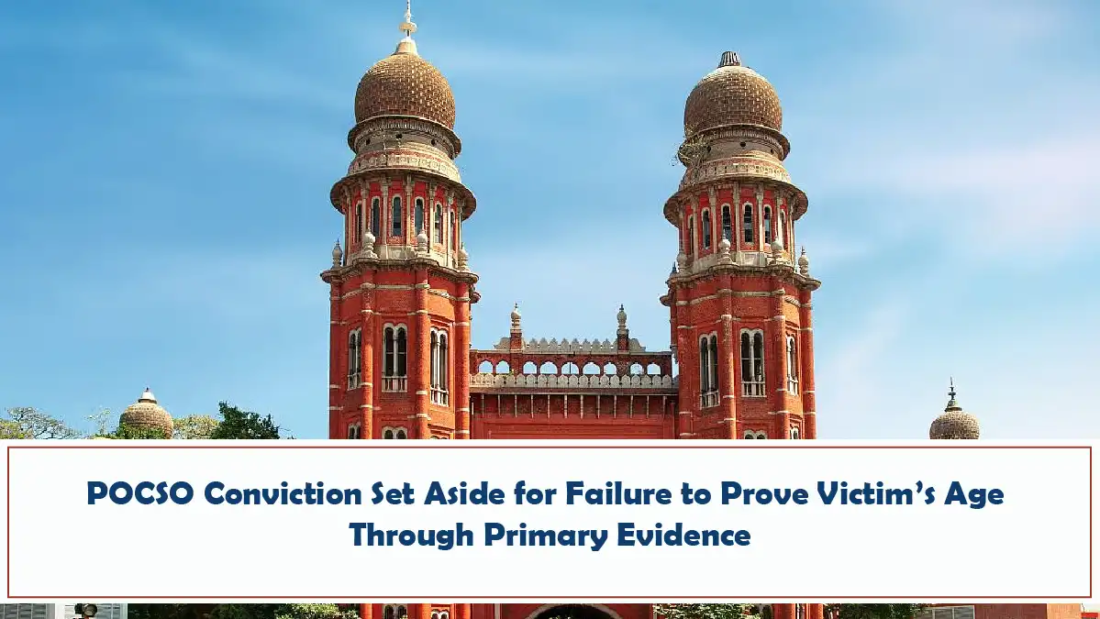
Case: Mahesh v. State represented by Inspector of Police, Nagercoil AWPS – Madras High Court (Madurai Bench)
Factual Background
The appellant preferred a criminal appeal challenging the judgment of the Special Court for Exclusive Trial of POCSO Cases, Kanyakumari, which convicted him under Section 366 of the Indian Penal Code and Section 5(l) read with Section 6 of the Protection of Children from Sexual Offences Act, 2012 (POCSO Act). The trial court sentenced the appellant to five years’ rigorous imprisonment under Section 366 IPC and twenty years’ rigorous imprisonment under the POCSO Act.
According to the prosecution, the victim girl, aged about 16 years at the time of the occurrence, had become acquainted with the appellant, who was a friend of her elder brother. The appellant allegedly expressed his love for the victim and proposed marriage. On 4 March 2018, the victim left her parental home and joined the appellant. The prosecution alleged that the appellant took her to his uncle’s residence where they got married and thereafter repeatedly had sexual intercourse with her until his arrest on 5 April 2018 following information received through the Child Helpline (1098).
Subsequently, the victim lodged a complaint, leading to the registration of an FIR and investigation under the provisions of the POCSO Act. During trial, the prosecution examined seventeen witnesses and relied upon documentary evidence, including a birth certificate and transfer certificate, to establish that the victim was a minor. Based on this evidence, the Special Court convicted and sentenced the appellant.
Court’s Analysis
The High Court examined whether the prosecution had satisfactorily established the age of the victim, which was a crucial requirement for attracting the provisions of the POCSO Act. The prosecution relied upon xerox copies of the birth certificate and transfer certificate to determine the victim’s age.
The Court observed that these documents constituted secondary evidence. The prosecution had failed to produce the original documents or offer any explanation for their non-production. Significantly, the victim herself stated during her testimony that the original documents were available.
Reiterating settled principles under the law of evidence, the Court held that primary evidence must ordinarily be produced and that secondary evidence may be admitted only when proper justification for the absence of the original documents is provided. In the absence of such justification, the photocopies relied upon by the prosecution were inadmissible.
Once the birth certificate and transfer certificate were excluded from consideration, the prosecution was unable to establish the age of the victim. Since proof of minority is a foundational requirement for offences under the POCSO Act, the failure to establish the victim’s age rendered the prosecution case unsustainable.
The Court further observed that the facts of the case appeared to reflect a consensual adolescent relationship that later became contentious due to parental opposition. It noted that similar cases frequently result in criminal prosecution of young boys under the POCSO Act despite the underlying relationship being consensual.
Order of the Court
The Madras High Court allowed the criminal appeal and set aside the conviction and sentence imposed by the trial court. The appellant was acquitted of all charges and directed to be released from custody forthwith unless required in connection with any other case.
The Court also directed the Chief Secretary of the State of Tamil Nadu to ensure effective implementation of Section 43 of the POCSO Act by creating public awareness about the stringent provisions of the Act through awareness programmes in schools, colleges, and public forums.
Written by Adv. K. Sri Hamsa