 Cart is empty

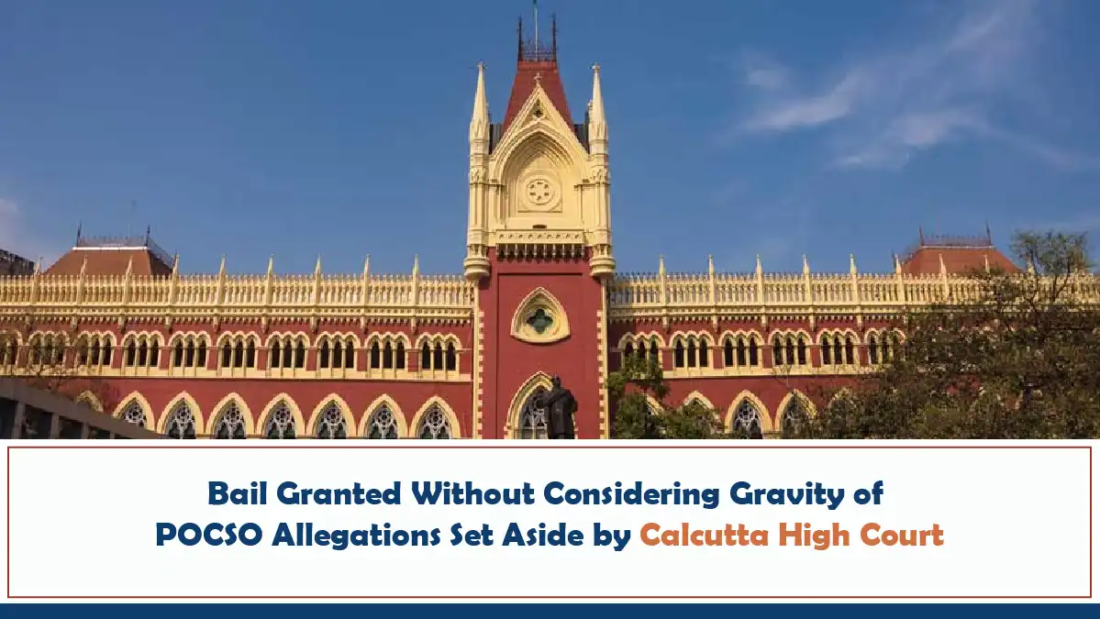
Bail Granted Without Considering Gravity of POCSO Allegations Set Aside by Calcutta High Court
Case: X v. State of West Bengal & Anr.
Factual Background
The present application before the Calcutta High Court sought cancellation of bail granted to the accused by the Additional Sessions Judge, Contai in connection with offences under Section 376(3) of the Indian Penal Code and Section 6 of the Protection of Children from Sexual Offences Act, 2012 (POCSO Act). The FIR had been lodged by the mother of a fourteen‑year‑old minor girl alleging that the accused had sexually exploited her daughter.
According to the complaint, the accused, who was the victim’s English tutor, allegedly subjected the minor to repeated acts of sexual assault and captured objectionable photographs which were used to threaten and blackmail her. The victim later disclosed the incident to her grandmother after suffering severe psychological distress and reportedly attempting suicide. Medical records also indicated that the victim had been subjected to sexual intercourse with the accused during the relevant period.
The accused initially sought anticipatory bail, which was rejected by the trial court. After surrendering before the court, his application for regular bail was also rejected considering the seriousness of the allegations. Subsequently, a charge sheet was filed shortly after registration of the FIR, following which the trial court granted bail primarily on the ground that the investigation had been completed.
Aggrieved by this decision, the de facto complainant approached the High Court seeking cancellation of bail, contending that the order granting bail was mechanical and failed to consider the gravity of the offence, the vulnerability of the minor victim and the possibility of witness intimidation.
Court’s Analysis
The High Court first considered the maintainability of the application for cancellation of bail. Referring to the principles laid down by the Supreme Court in Gurcharan Singh v. State (Delhi Administration) and Puran v. Rambilas, the Court held that the High Court possesses independent jurisdiction under Section 439(2) of the Code of Criminal Procedure to examine whether an order granting bail suffers from illegality, perversity or non‑application of mind.
Upon examining the impugned order, the Court observed that the trial court had earlier rejected bail after noting the existence of incriminating material against the accused. However, within a short span of time the same court granted bail solely on the ground that a charge sheet had been filed, without analysing the seriousness of the allegations or the evidence available in the case diary.
The Court reiterated that while granting bail, courts must consider several well‑established factors including the nature and gravity of the offence, severity of punishment, likelihood of the accused absconding, possibility of tampering with evidence and the impact on witnesses. The High Court emphasised that offences under the POCSO Act constitute serious crimes against society and therefore require heightened judicial scrutiny.
Order of the Court
The Calcutta High Court held that the order dated 20 July 2024 granting bail to the accused suffered from non‑application of mind and reliance on irrelevant considerations. Accordingly, the Court set aside the impugned order and cancelled the bail granted to the accused.
The accused was directed to surrender before the trial court within ten days from the date of the order, failing which the trial court was directed to take appropriate coercive steps for committing the accused to custody.
Written by Adv. K. Sri Hamsa