 Cart is empty

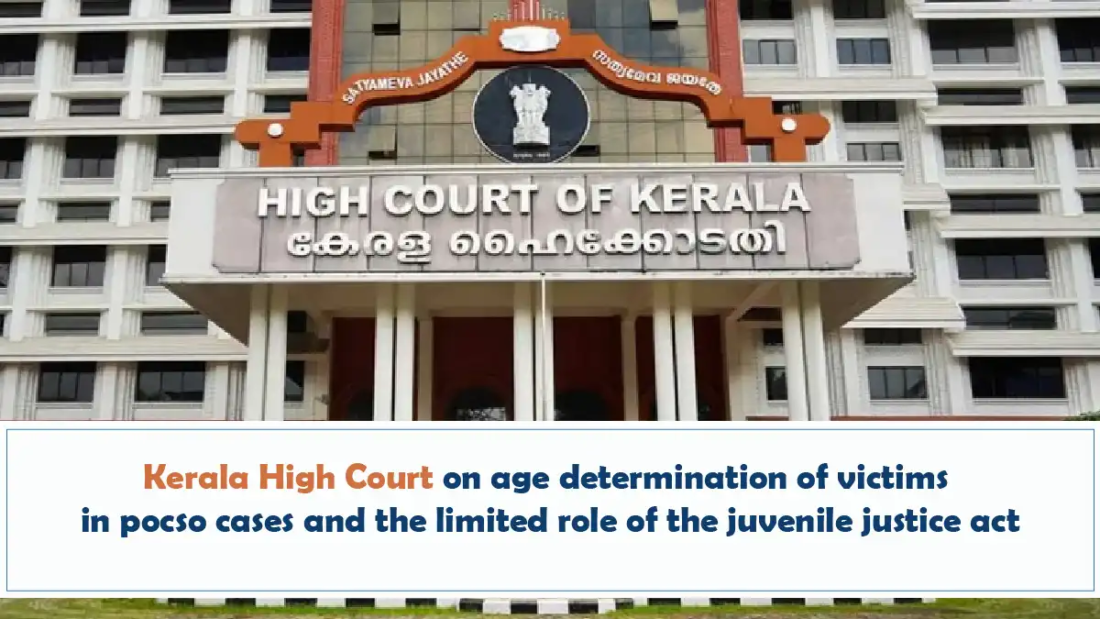
Suresh K. v. State of Kerala
Kerala High Court, decided in January 2026
Background and Facts
The Kerala High Court was seized of proceedings arising from a prosecution under the Protection of Children from Sexual Offences Act, 2012 (“POCSO Act”), where the applicability of the statute itself was questioned on the ground that the prosecution had failed to properly establish that the victim was below eighteen years of age at the time of the alleged offence. The accused contended that age determination under the POCSO Act must mandatorily follow the procedure prescribed under the Juvenile Justice (Care and Protection of Children) Act, 2015 (“JJ Act”) and the rules framed thereunder, and that any deviation from such procedure vitiated the prosecution.
The challenge before the High Court therefore centred on whether the Juvenile Justice framework constitutes the exclusive and binding mechanism for determining the age of a victim in POCSO prosecutions, or whether courts may rely on other forms of admissible evidence to arrive at such a determination.
Issues for Consideration
The principal issue before the Court was whether the age of a victim in a POCSO case can be determined only in accordance with the procedure prescribed under the Juvenile Justice Act, or whether the Special Court under the POCSO Act has the discretion to determine age on the basis of the totality of evidence placed on record. The Court was also required to consider the role of evidentiary principles under the Indian Evidence Act in such determinations.
Findings and Reasoning
The Kerala High Court held that the Juvenile Justice Act does not prescribe the sole or exclusive mode for determining the age of a victim in POCSO cases. While the JJ Act provides a structured statutory mechanism for age determination in matters concerning children in conflict with law or children in need of care and protection, those provisions cannot be mechanically transplanted into POCSO prosecutions to the exclusion of other legally admissible evidence.
The Court observed that the determination of whether a person qualifies as a “child” under the POCSO Act is a jurisdictional fact that must be assessed by the Special Court based on judicial satisfaction. Such satisfaction may be derived from documentary evidence such as birth certificates or school records, medical opinion, oral testimony of the victim or parents, and other relevant material recognised under the Indian Evidence Act. The JJ Act procedure, the Court clarified, may be adopted as one guiding method, but it does not override general evidentiary principles.
The High Court further emphasised that Special Courts are required to record reasons for accepting or rejecting evidence relating to age and that rigid adherence to a single statutory method would undermine the objective of fair adjudication. The Court also noted that once the age of the victim is established and the offence under the POCSO Act is made out, the statutory presumptions under the Act would operate in accordance with law.
Decision
The Kerala High Court clarified that age determination in POCSO cases is not confined to the framework of the Juvenile Justice Act and must be undertaken by the Special Court on the basis of the overall appreciation of admissible evidence. The Court rejected the contention that non-compliance with the JJ Act procedure, by itself, would invalidate a POCSO prosecution.
Written by Adv. Aiswarya Krishnan