 Cart is empty

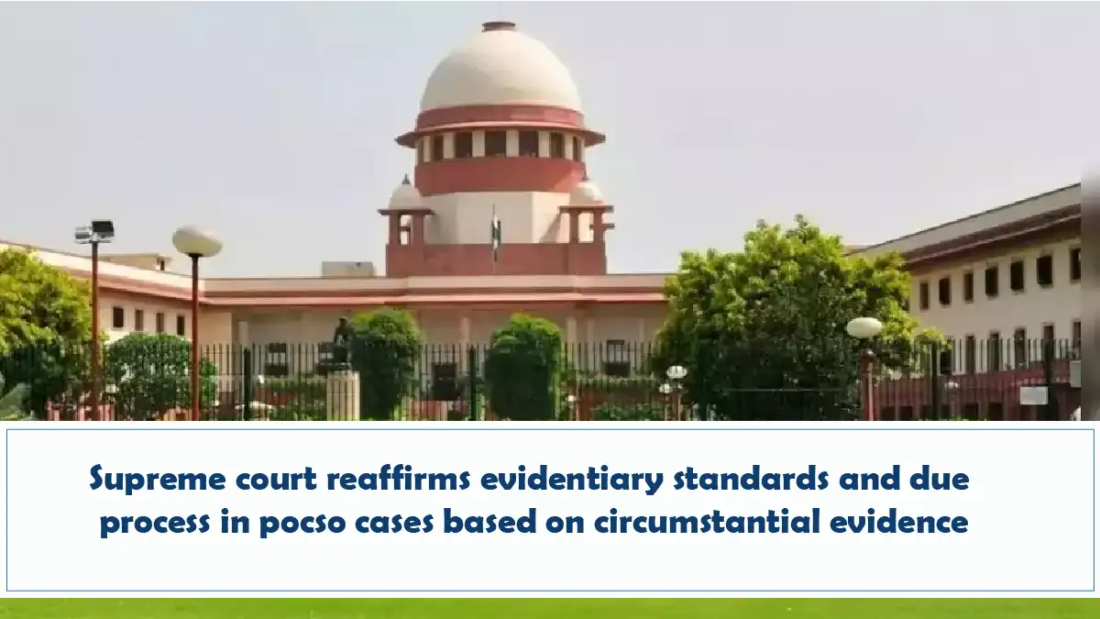
Facts
The case concerned the alleged sexual assault of a four-year-old child. Late at night, the child was found in a severely injured condition and taken for medical treatment. An informant lodged a First Information Report against unknown persons, stating that the child had been found without clothes and bleeding. Despite claiming knowledge of several surrounding circumstances, the FIR did not mention the identity or description of any suspect or of the persons who had allegedly been with the child prior to the incident.
During the investigation, several individuals were subsequently projected as witnesses to a “last seen together” circumstance, asserting that they had seen the child in proximity to the accused shortly before the incident. The accused was arrested and charged under provisions of the Indian Penal Code and the Protection of Children from Sexual Offences Act, 2012. The trial court convicted the accused and imposed life imprisonment, relying primarily on circumstantial evidence including medical findings, alleged recoveries and the last-seen theory. The High Court dismissed the appeal and affirmed the conviction.
Issues
The Supreme Court considered whether the conviction could be sustained when the prosecution case was founded entirely on circumstantial evidence, whether material omissions in the FIR undermined the credibility of the prosecution, whether the “last seen together” theory was reliable in light of the conduct and testimony of witnesses, and whether serious investigative lapses vitiated the trial.
Arguments
The defence contended that the FIR was fundamentally defective as it omitted essential facts that were admittedly within the informant’s knowledge at the time of reporting. It was argued that the later introduction of witnesses to support the last-seen theory was an afterthought and that their conduct was highly unnatural and inconsistent with normal human behaviour. The defence further highlighted multiple investigative lapses, including failure to promptly identify or examine key individuals, failure to collect critical forensic material and failure to establish a credible chain of circumstances.
The prosecution argued that the medical evidence conclusively established sexual assault and that the circumstantial evidence, taken cumulatively, pointed only to the guilt of the accused. It was submitted that minor inconsistencies or omissions should not outweigh the gravity of the offence, particularly in a case involving a child victim under the POCSO Act.
Findings
The Supreme Court reiterated the settled legal principles governing conviction based solely on circumstantial evidence, emphasising that every link in the chain must be firmly established and must exclude every hypothesis consistent with innocence. Applying these principles, the Court found that the prosecution failed to meet this standard.
The Court held that while an FIR need not be encyclopaedic, the omission of material facts that were admittedly known to the informant seriously eroded the credibility of the prosecution case. The delayed introduction of the last-seen witnesses, coupled with contradictions and unnatural conduct, rendered their testimony unreliable. The Court was particularly critical of the investigative approach, noting that crucial steps expected in a serious POCSO offence were either delayed or entirely omitted.
The judgment underscored that investigative apathy and procedural infirmities cannot be glossed over merely because the offence alleged is grave. The Court observed that miscarriage of justice can occur not only through acquittal of the guilty but also through conviction based on unreliable evidence.
Final Order
The Supreme Court allowed the appeal, set aside the conviction and sentence, and ordered the release of the accused. The Court clarified that sympathy for the victim, however compelling, cannot substitute for proof beyond reasonable doubt and that due process and evidentiary discipline remain fundamental even in prosecutions under the POCSO Act.
Written by Adv. Aiswarya Krishnan